
Mobilizing Workforces Across the Americas
16 Jan, 20269:46Key Takeaways: Trade dynamics continue to shift from a Canada-US focus to a broader Ame...


Key Takeaways:
- Trade dynamics continue to shift from a Canada-US focus to a broader American strategy. New US trade policies and tariffs are prompting Canada to actively deepen partnerships in the Caribbean, offering fresh opportunities in the region.
- Cross-border workforce mobility solutions are now a strategic necessity for capitalizing on these opportunities. In sectors like oil & gas, renewables, and mining, project success depends on the ability to deploy skilled talent quickly and compliantly across international borders.
- The primary barriers to expansion are regulatory, not operational. Companies face a complex maze of local employment laws, payroll tax systems, and immigration rules, making the traditional approach of setting up a local entity slow, expensive, and high risk.
- Employer of Record (EOR) services remove the traditional barriers to cross-border workforce deployment. An EOR simplifies expansion by serving as the legal employer of your workforce in a foreign country, handling compliance, payroll, and risk, while you retain full operational control of the employee’s work.
- Using EOR services converts a complex administrative challenge into a strategic advantage. It enables speed to market, mitigates compliance risk, and allows leadership to focus on core business objectives like project execution and development.
The geopolitical and economic landscape of the Americas is changing, and while the Canada-US trade relationship remains an important economic pathway, governments are increasingly looking to new markets. The Canadian government is actively pursuing and strengthening trade partnerships beyond its southern border, reaching into the Caribbean and Latin America, not as a retreat from the US, but as a move to engage with growing demand for expertise in energy and natural resources. For oil & gas, renewables, and mining, this diversification opens the doors to projects that were previously logistically or politically challenging. But this comes with an important question: how do you quickly mobilize a skilled, compliant workforce across multiple international jurisdictions to capitalize on these opportunities?
The New Map of North American Trade
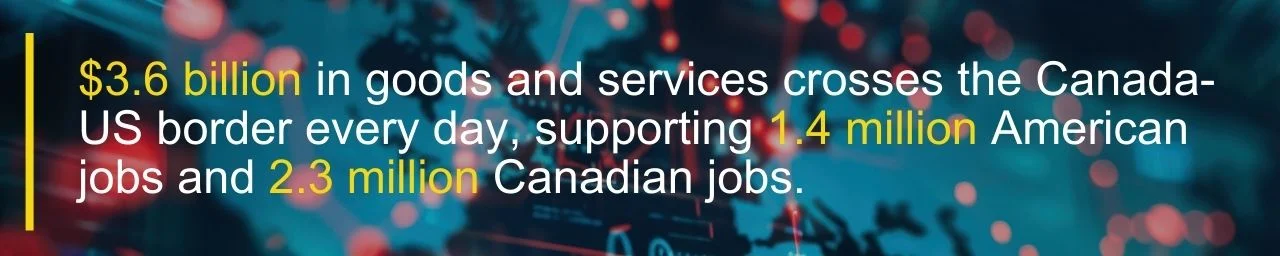
The importance of Canada-US trade is huge. According to the Canadian Chamber of Commerce, $3.6 billion in goods and services crosses the Canada-US border every day ($1.3 trillion annually), supporting 1.4 million American jobs and 2.3 million Canadian jobs.
Throughout 2025, the US administration announced a raft of new trade tariffs affecting many countries across the world, including Canada. Aside from the initial shock to markets and several other countries imposing reciprocal tariffs on the US, the impact has been compounded as some of these tariffs have subsequently been amended, leading to uncertainty for businesses and investors.
As the Canada-US trade dynamic recalibrates, the two countries are still deeply integrated due to the highly interconnected energy system and other resources, while new factors are influencing the flow of goods, capital, and expertise. This has brought a sharp focus to Canada’s relationship with other regions across the Americas, such as the Caribbean, for trade and investment opportunities.
This expansion of trade horizons means that Caribbean nations are now looking to Canada for investment in oil & gas and renewable energy infrastructure, as well as for mining , seeking alternatives and partnerships that diversify their own economic ties. The trade flows between these countries are growing, and so the ability to move workforce talent seamlessly across these borders is what will separate the market leaders from the spectators.
Mobilizing Talent in Energy and Resources
The demand for specialized skills is universal, but the application is sector-specific:
- Oil & gas: The US administration’s interest in securing affordable energy has boosted prospects for conventional reserves, but attention is also turning to more complex extraction sites and downstream projects in new regions. Deploying engineers, geologists, and skilled tradespeople to these locations requires a solid understanding of local labor laws and visa regulations.
- Renewables: This sector is booming in North America, with significant potential also in the Caribbean. As in other regions such as Asia-Pacific and Scandinavia, the demand for engineers, project managers, and specialists is intense. Speed to market is critical, and delays in staffing can derail project timelines and funding.
- Mining: The global energy transition is fueling demand for critical minerals like lithium, cobalt, and copper. Canada, a global mining leader, is seeing its companies in high demand to develop mines across the Americas. Sending skilled workers to remote and often highly regulated environments remains a core challenge.
In all three sectors, the common thread is that project success is directly tied to having the right people, in the right place, at the right time - and in full compliance with local regulations.
Barriers to Cross-Border Workforce Deployment
The enthusiasm for new project opportunities is often tempered by the complex reality of cross-border expansion. When deploying talent, companies face a maze of challenges:
- Regulatory hurdles: Each country has its own unique set of rules governing employment, taxation, benefits, immigration, and so on. Misclassifying an employee as a contractor, for example, can lead to severe financial penalties and legal repercussions.
- Payroll and tax complexities: Ensuring the correct amount of income tax, social security, and other statutory deductions across different jurisdictions is a monumental task. Errors can damage employee morale and attract the unwanted attention of local tax authorities.
- Entity establishment: The traditional approach of setting up a local (in-country) legal entity is time-consuming and expensive, and it commits a company to a long-term presence it may not want. For a single project or small team, this is often not a viable option.
These barriers can stall a project before it even begins, causing companies to miss valuable opportunities.
Simplifying Expansion with Employer of Record Services
To navigate the complexity of the evolving international trade dynamics, strategic workforce mobility solutions, specifically Employer of Record (EOR) solutions, are vital.
An EOR is a legally established entity in a foreign country that hires your selected talent on your behalf. The EOR assumes all the legal employer responsibilities - from payroll and benefits administration to tax deductions and compliance with local labor laws. But importantly, your company retains full operational control over the employee’s day-to-day work and project output.
For a company looking to expand into the Americas, an EOR solution provides:
- Speed: Deploy a fully compliant workforce in weeks, not the months or years that are required to establish your own entity.
- Risk mitigation: Transfer the legal and financial risks of non-compliance to a dedicated expert.
- Focus: Allow your leadership to concentrate on project execution and business development, not the intricacies of international HR law.
Capitalizing on the New Trade Landscape in the Americas
The shifting trade dynamics between Canada, the US, and the Caribbean are creating new opportunities for project collaboration in the energy and resource sectors. The companies that will thrive are those that view workforce mobility as a core strategic capability.
By using an EOR solution, you can transform the complex challenge of cross-border hiring into a straightforward, de-risked process.
NES Fircroft offers specialized recruitment services for oil & gas, renewables, and mining projects throughout the Americas. Our partnership provides clients with access to extensive expertise and established professional networks across North America, Canada, and the Caribbean. We are also CARICOM registered for entry to the Caribbean.
Contact us today to discuss how our workforce mobility solutions and specialized EOR support can help you to make the most of these new trade opportunities in the Americas.

FAQs
How do these changes affect cross-border projects in energy and mining sectors?
New trade agreements and diplomatic channels are creating project opportunities in oil & gas, renewables, and mining across the Americas. Success depends on the ability to mobilize skilled talent quickly and compliantly across multiple jurisdictions.
Why is workforce mobilization important to resource projects in the Americas?
Energy and mining projects hinge on speed and expertise. The quick deployment of skilled teams ensures that timelines remain intact, and funding and contracts stay secure.
What challenges do companies face when sending employees abroad?
The biggest hurdles are regulatory, such as differing labor laws, payroll systems, and immigration rules. Setting up local entities is often too slow or costly for short-term or specialized projects.
How can Employer of Record (EOR) solutions help?
Having an Employer of Record partner takes on the legal employer role in-country, managing compliance and payroll. This lets you focus on execution while deploying talent in weeks instead of months.