Top Recruitment Challenges in France
16 Mar, 2026


Key Takeaways: Billions are being invested in Europe’s life sciences CapEx sector, supp...


Europe’s life sciences sector is pouring resources into new infrastructure, with pharmaceutical, biotech, and medtech companies steadily expanding their manufacturing footprint. CBRE notes that London alone has 2.7 million sq. ft of lab and R&D space under construction, making it one of the world’s most active markets for scientific real estate development.
The investment in these new facilities is creating a steady need for engineers who can design, build, and commission complex assets. With projects in development, companies are placing greater focus on the specific roles and technical strengths that keep CapEx projects moving and ensure sites are ready for operation.
Europe’s standing as a global leader in life sciences is reinforced by long-term health and demographic trends. An ageing population and rising chronic disease burden are driving sustained demand for medicines and advanced therapies, prompting companies to increase manufacturing capacity.
Investment momentum reflects this confidence: in early 2025, €1.2 billion flowed into European life sciences start-ups, accounting for over half of regional deal value, while global venture capital in the sector surged 43% above 2019 levels in 2024, with Europe capturing a rising share.
Plus the region’s innovation output is strengthening, with over 40,000 health-biotech patents granted in Europe over the past five years. Germany leads on total patent applications, while the UK recorded one of Europe’s fastest growth rates.

The region continues to expand biologics and high-value therapeutic capacity. Belgium, Ireland, and Switzerland have all increased pharmaceutical export value.
Companies are revising their CapEx strategy by prioritising upgrades to existing manufacturing sites to accelerate market entry and avoid delays caused by lengthy grid connections.
Europe’s CapEx landscape varies by country:
These developments, combined with Europe’s role as home to 24% of the world’s R&D companies, create sustained demand for CapEx engineering jobs.
Project managers take ownership of the entire delivery cycle, guiding projects from early concept and feasibility through detailed design, procurement, construction, commissioning, qualification, and final handover. They orchestrate multidisciplinary teams, manage risk alongside schedule and cost controls, and maintain clear and consistent communication with senior leadership and regulatory bodies.
Key skills:
Process engineers design and optimise the operations that will run inside new or expanded assets. Their responsibilities include bioprocess design for upstream and downstream operations, aseptic filling lines, packaging operations, and tech transfer into new equipment and layouts.
Key skills:
Automation engineers implement the control architecture that underpins modern manufacturing, bringing together PLC, DCS, SCADA, MES, and electronic batch record systems. Their goal is to safeguard data integrity and ensure full compliance with 21 CFR Part 11 and GAMP 5 standards.
Key skills:
CQV engineers play a critical role in bringing new pharmaceutical facilities and equipment into compliant operation. They lead and execute commissioning, qualification, and validation activities across utilities, process equipment, cleanrooms, and computerised systems. Their work ensures that assets are fit for purpose, inspection-ready, and capable of supporting commercial production.
Key skills:
HSE managers ensure that large-scale pharmaceutical construction and operational projects are delivered safely, sustainably, and in full compliance with local and international regulations. They establish and enforce health, safety, and environmental standards across site activities, construction phases, and operational readiness.
Key skills:

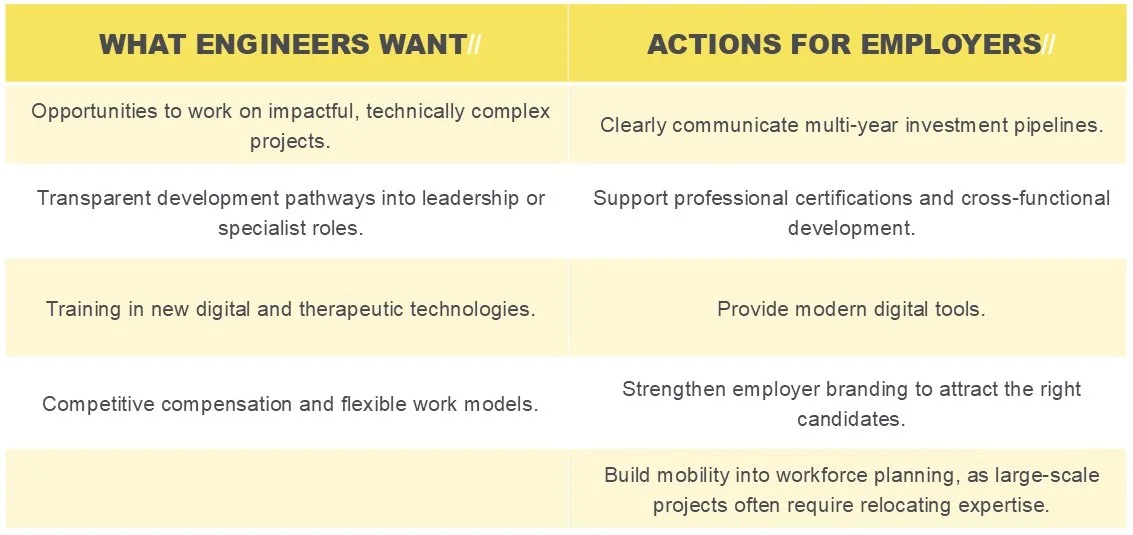
Across all CapEx disciplines, employers increasingly value:
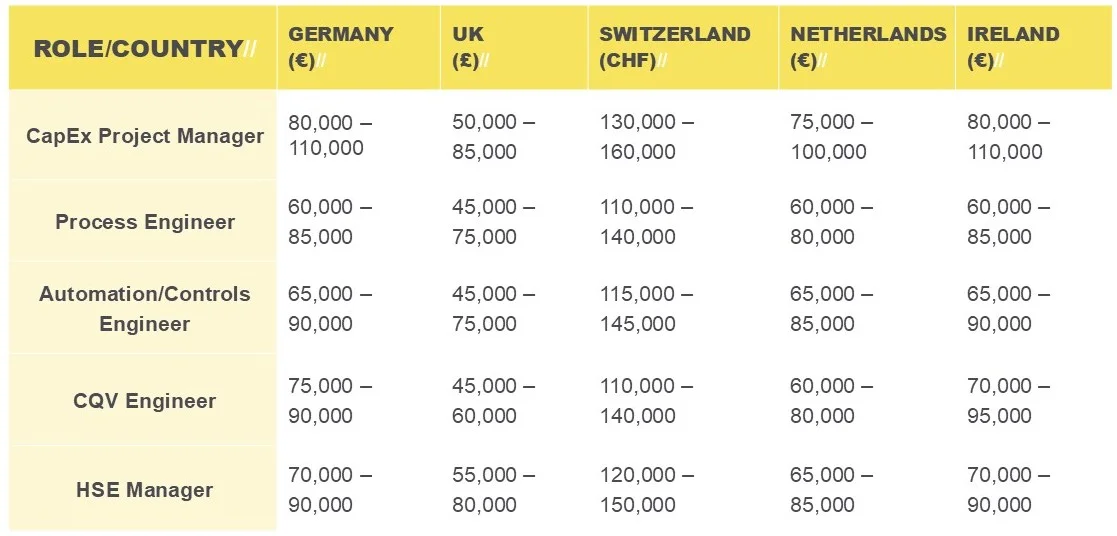
These ranges reflect aggregated benchmarks for experienced engineers (typically 5-10+ years) based on Eurostat labour cost data, OECD earnings, and salary data sets for engineering and technical occupations. Salaries can exceed these bands depending on seniority, specialisation, or location, and comprehensive benefits packages are often provided in addition to base pay.
NES Fircroft has an established presence across the continent, with 15 offices located throughout Europe, close to life science clusters, and is supported by a broader network of 80 offices worldwide. We have specialists in contract staffing and permanent hiring, payroll, global mobility, and compliance, ensuring that you can secure a high-performing engineering workforce or be matched with the right opportunities.
For businesses preparing to secure engineering capability or refine workforce plans, get in touch to discuss how our CapEx recruitment team can develop your hiring strategy. Professionals seeking new roles in life sciences can explore our latest engineering jobs.

CapEx engineers overall design, build, and commission new or upgraded pharmaceutical and biotechnology facilities, ensuring compliance and integrating advanced technologies.
Ireland, Switzerland, Germany, France, the Netherlands, and the UK lead, with London among the busiest construction markets. Denmark and Belgium also remain strong R&D hubs. NES Fircroft has entities in all of these locations, providing local, on-the-ground support.
Salaries for experienced CapEx engineers in Europe are highly competitive and vary by country. For example, ranges in Germany often fall between €65,000 and €110,000, the UK typically sees £45,000 to £85,000, and Switzerland offers some of the highest bands, from CHF 110,000 to 160,000.
Work with a specialist recruitment partner that has networks in leading life science clusters. Finding the right candidate requires more than posting a job ad; it demands access to a network of highly specialised professionals and recruiters who understand the technical and regulatory complexity of the role. Learn more about our life sciences recruitment capabilities here.
Partner with a life sciences recruiting firm that offers flexible staffing models such as contract staffing or global mobility support, and access to pre-qualified talent. This reduces time-to-hire, ensures compliance, and lowers overhead costs while securing experienced engineers for complex projects.