
Top Recruitment Challenges in France
16 Mar, 202610:45Key Takeaways: France’s recruitment market is under structural pressure. A widening ski...


Key Takeaways:
- France’s recruitment market is under structural pressure. A widening skills gap, talent shortages, competition for talent and complex local labour laws indicate a market where supply and demand are increasingly misaligned.
- The skills gap is a long-term issue. With 72% of French companies citing skilled worker shortages as an investment barrier, and STEM enrolments falling below the EU average, the mismatch between employer needs and available talent is set to deepen.
- Several sectors face acute shortages, including engineering, construction, ICT, and healthcare and life sciences. Vacancy rates are high and demographic pressures, such as the retirement of baby-boomer workers, are set to intensify competition for qualified professionals.
- This talent scarcity shifts the balance of power towards candidates. In short-supply disciplines, top professionals often receive multiple offers, making the employer’s brand, speed and quality of the candidate experience decisive factors in securing the right people.
- Effective hiring demands a strategic, locally informed approach – for example, adopting workforce solutions via a specialist recruitment agency in France, such as NES Fircroft, that account for regional variation, maintain active talent pipelines and integrate regulatory expertise.
France is one of Europe’s most significant economies and, by extension, one of its most important recruitment markets. But for companies looking to build strong teams in the country, the path from vacancy to offer is rarely straightforward. Talent shortages, a heavily regulated employment environment and intensifying competition for skilled professionals are changing how organisations approach hiring.
So, what are the workforce solutions in France that companies can use to stay ahead?
The French Staffing Market at a Glance
In 2024, France was the second-largest economy in the EU. Looking ahead, the country’s GDP is expected to grow from 0.7% in 2025 to 1.1% in 2027.
The staffing market is characterised by a strict legislative environment, strong collective bargaining agreements (CBAs) and a relatively underdeveloped professional staffing sector compared to other major economies.
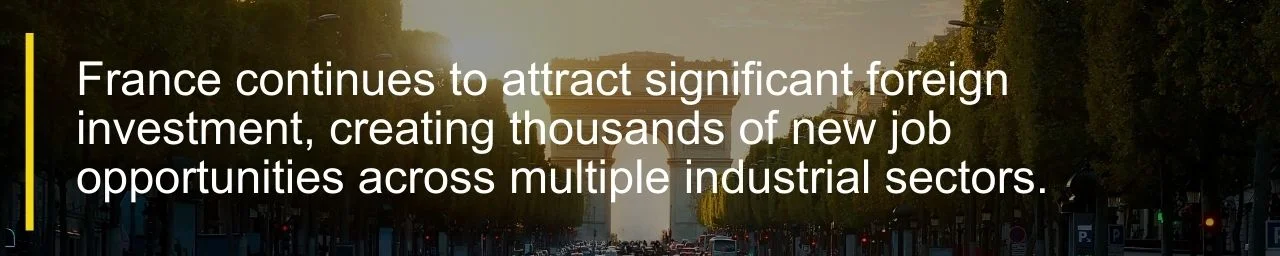
Despite recent economic headwinds – such as France’s temporary workforce contracting by 3.0% in October 2025 – the long-term outlook remains positive. The number of employed people in France is forecast to remain stable at just over 29 million in 2026 and the country continues to attract significant foreign investment, creating thousands of new job opportunities across multiple industrial sectors.
The question isn’t whether the skilled talent is needed, but whether it can be found – and retained.
The Widening Skills Gap: A Structural Problem
The skills gap in France is not a recent phenomenon. However, it has deepened over time, driven by mismatches between what the education and training system produces and what employers actually need. According to Cedefop in 2025, 72% of companies in France reported shortages of skilled workers as an investment barrier and 62% of SMEs reported difficulties in finding employees with the right skills.
While demand for STEM (science, technology, engineering and maths) specialists is high in France, tertiary enrolments are falling. In 2023, only 23.7% of tertiary education students were enrolled in STEM, which is below the EU average of 26.8% – it is also less than in 2015 (25.3%)
This is compounded by underrepresentation: in 2023, women accounted for just 28.3% of engineering students and 18.4% of ICT students, limiting the available talent pool further still.
For companies operating in technical or industrial sectors, the skills gap in France is a long-term strategic issue that requires a proactive workforce solution.
Talent Shortages: Where the Pressure Is Most Acute
Several industrial sectors are under particular pressure:
1. Technology
France’s technology sector is expanding rapidly, with the digital transformation market projected to reach $91 billion by 2030. But in 2023, the ICT sector had a relatively high vacancy rate of 3.9%.
Demand for AI specialists, cybersecurity professionals and data engineers is surging, but supply cannot keep pace. More than 15,000 cybersecurity positions remain unfilled in France and the ICT talent shortage continues to widen as investment in the sector grows, through initiatives such as French Tech 2030.
Nevertheless, ICT services are consistently identified by Cedefop as leading employment growth to 2030.
2. Construction and Engineering
Construction and engineering recruitment in France is also particularly competitive. For construction, the vacancy rate was even higher than technology at 4.1% in 2023, with an estimated 272,990 vacancies in 2025. In addition, there were 220,000 vacancies in the broad engineering category of ‘installation and maintenance (construction, networks, machinery)’.
The impending retirement of thousands of baby-boomer workers by 2030, combined with accelerating demand from the energy transition, is only likely to intensify this pressure.
3. Healthcare and Life Sciences
In France, there is significant demand for workers in life sciences and healthcare sector, driven by an ageing population and increasing demand for medical professionals, pharmacists and MedTech specialists.
The French government has taken steps to address this, such as easing its Blue Card rules which apply to healthcare workers from other countries – a recognition that domestic training pipelines cannot fill the gap alone.
Competition for Talent Is More Than a Numbers Game
The recruitment challenge also runs even deeper than just the availability of skilled workers: top candidates in short-supply sectors often receive multiple offers and so have significant leverage. The company’s brand, speed and quality of the candidate experience all determine whether the best professionals choose your organisation or a competitor.
Referral-based hiring in France also consistently runs higher than the global average, meaning that companies with strong internal networks and positive reputations attract talent more efficiently than those relying solely on job boards.
For international companies entering the French market or scaling operations, building that reputation from scratch – and doing so in a way that resonates with local and international candidates – is a major undertaking.
Local Labour Regulations Demand Expertise
Any discussion of recruitment challenges in France must include the complexity of its employment laws. The French Labour Code (Code du travail) is among the most comprehensive in Europe, covering everything from contract types and working hours, to termination procedures, and discrimination and whistleblowing protections. Non-compliance carries real consequences, including criminal liability for worker misclassification and substantial fines for procedural failures.
Over 95% of employees in France are covered by CBAs, even in non-unionised industries. These agreements often provide enhanced terms beyond the Labour Code’s baseline – on pay, working time, leave and benefits – and vary considerably by sector. Understanding which CBA applies to a given role, and ensuring full compliance with its terms, is not straightforward for organisations without deep local knowledge.
For international businesses hiring in France, these requirements demand dedicated expertise – and the cost of getting them wrong is high.

NES Fircroft: Your Specialist Recruitment Agency in France
At NES Fircroft, we have spent many years building the local expertise and global reach that effective recruitment in France demands. Our approach is proactive: we maintain active talent pipelines in engineering, technology, life sciences and beyond, so that when your hiring need arises, we are already ahead of the market.
We also understand that finding the right candidate is only part of the challenge. Our team supports clients with employer-branding strategies that resonate with French professionals, helping you articulate what makes your organisation an attractive destination for talent.
Alongside this, our regulatory expertise means that every hire is legally compliant from day one – from contract type and CBA alignment, to social security obligations and worker classification.
Whether you’re a multinational scaling your French operations or a growing business hiring in France for the first time, our team is ready to work alongside you as a strategic partner.
To discuss your current or upcoming hiring needs in France, get in touch with our French team today.
FAQs
What jobs are in shortage in France?
The most in-demand roles are found in engineering, construction, ICT, healthcare and life sciences, along with retail, accountancy and hospitality. In the technology sector alone, more than 15,000 cybersecurity positions remain unfilled nationally, and demand for AI and data engineering talent continues to outstrip supply.
What are the labour laws in France?
Employment law is primarily governed by the French Labour Code (Code du travail), which sets minimum standards for contracts, pay, working hours, leave and termination.
The majority of workers are also covered by sector-specific collective bargaining agreements (CBAs), which frequently provide enhanced terms beyond the statutory baseline.
How do we ensure our hiring process in France stays compliant?
Compliance in France requires a thorough understanding of the Code du travail, applicable CBAs, and obligations around worker classification, written contracts and social security contributions. Partnering with a specialist recruitment agency, like NES Fircroft, with proven expertise in France is one of the most reliable ways to manage this complexity.
Where can I find recruitment agencies that specialise in hard-to-fill roles in France?
A specialist recruitment agency in France with sector-specific expertise, such as NES Fircroft, offers the most effective solution. Generalist platforms and job boards rarely have access to the candidate networks that a specialist agency maintains, particularly in disciplines such as engineering, ICT and life sciences.
At NES Fircroft, we operate talent acquisition services across multiple industrial sectors in France, combining on-the-ground local knowledge with an international reach that broadens the available talent pool.
Related Posts


Data Centers: Hiring Trends and Skills Demand
12 Feb, 2026