How is Saudi Arabia’s Economy Supporting Chemical Industry Growth?
09 Dec, 20258:44Insights: Saudi Arabia is expanding from basic petrochemicals into specialty chemicals,...

Insights:
- Saudi Arabia is expanding from basic petrochemicals into specialty chemicals, advanced polymers, and downstream processing, supported by national industrial planning.
- The NIS aims to increase downstream chemical output fourfold by 2035, adding ~58.2B SAR to GDP and around 108,000 jobs.
- Major projects such as the Amiral complex and Yasref expansion highlight continued investment.
- Growth in the sector is increasing demand for specialist engineering, process, R&D, and operational professionals across Jubail, Yanbu, and the Eastern Province.
- NES drives this growth by leveraging expertise in the chemicals technical sector, delivering project services, and enabling global workforce mobility.
Saudi Arabia’s chemicals sector has been a significant part of the national economy for many years, but the focus of the industry is changing. While large-scale petrochemical production remains a focal point, there’s now a clear move towards more advanced and diversified chemical products, such as specialty chemicals, engineered polymers, and high-performance materials. These products all feed into various sectors like pharmaceuticals, construction and infrastructure, automotive, packaging, and electrical manufacturing, which are all areas that the Kingdom aims to continue developing.
This transition is closely linked to Vision 2030, as the country expands its industrial base beyond oil and develops supply chains that generate long-term economic value and skilled employment opportunities.
Why is Saudi Arabia positioned to grow in specialty and performance chemicals?
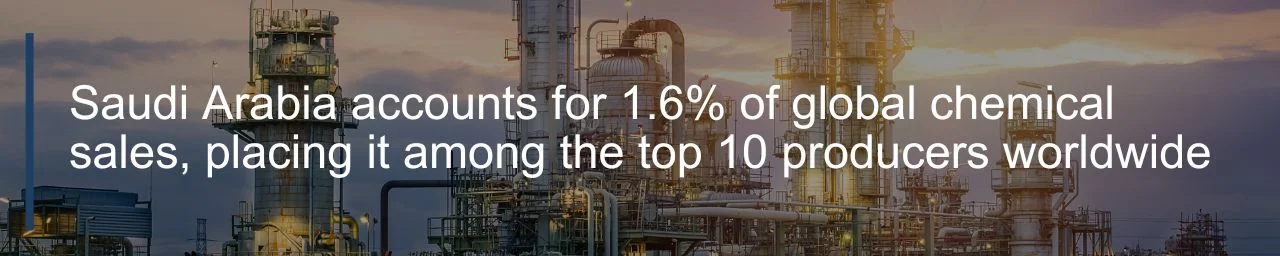
Saudi Arabia already contributes 51% of total manufacturing GDP in the GCC, making it a major industrial centre in the region. The country also accounts for 1.6% of global chemical sales, placing it among the top 10 producers worldwide (Gulf Petrochemicals & Chemicals Association (GPCA)).
This leadership is built on many factors that support maintained growth:
- Access to competitive feedstocks and established refining infrastructure and derivative plants
- Large industrial zones, including Jubail and Yanbu, with ready-to-expand capacity
- Efficient transport and export networks that reach global markets efficiently
- Strong partnerships with international chemical and manufacturing firms
- Commitment to industrial policy aligned with Vision 2030
These strengths provide a solid foundation for the industry to scale higher-value products. Specialty and performance chemicals typically offer higher margins than basic chemicals and support related sectors such as medical manufacturing and advanced construction materials.
This means the benefits of growth aren’t limited to chemical production; they extend across the broader economy through job creation, technology transfer, and industrial diversification.
Government Support and Industrial Planning
The National Industry Strategy (NIS) outlines how the chemicals industry will expand in the coming decade, setting a clear roadmap for diversifying product portfolios and capturing greater value from hydrocarbon resources. One of its primary goals is to increase downstream chemical output by four times by 2035, which is expected to contribute around 58.2B SAR to the economy and generate approximately 108,000 jobs through localisation.
Supporting measures include the Standard Incentives Programme, launched in 2025, which provides funding (SAR 10 billion) of up to 35% of the capital investment for qualifying chemical and manufacturing projects. This support is allocated during both construction and production stages, helping reduce project risk and encouraging new entrants to the sector.
Additionally, regulatory bodies such as the Saudi Accreditation Centre help ensure that products meet international specifications, supporting the competitiveness of Saudi-made chemicals in export markets.

Growth Outlook: What will the sector look like by 2035?
The Kingdom currently accounts for around 4.7% of global chemical production, primarily in basic and intermediate petrochemicals. But several downstream areas are projected to grow considerably:
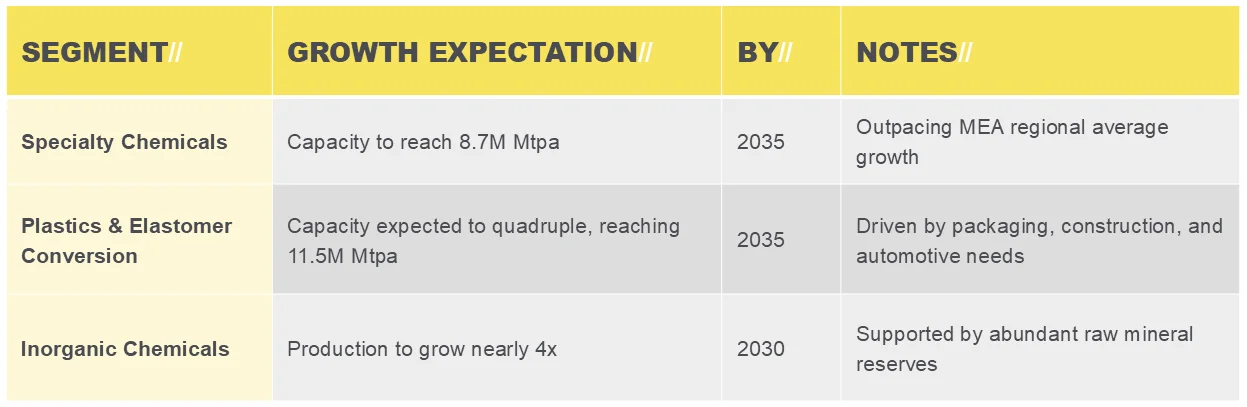
(Source: Industrial Centre)
This growth will be concentrated in the Eastern Province, Riyadh, and Western Province regions, which are already home to logistics networks and major refining assets.
Major Players and New Chemical Activity in Saudi Arabia
Globally recognised names lead Saudi Arabia’s chemical industry:
- Saudi Aramco – Integrating upstream & downstream to drive higher value capture, including acquiring 70% of SABIC.
- SABIC – Leading R&D programmes in specialty polymers, sustainable materials, and engineered chemicals.
- Sadara (Aramco + Dow JV) – Advanced chemical production through knowledge and technology transfer.
Recent high-profile investments include:
- Tasnee’s new complex in Jubail, targeted to produce around 3.3 million metric tonnes of polymers and petrochemical products each year, was recently approved by the Ministry of Energy.
- The Yasref refinery expansion in Yanbu, undertaken by Aramco and Sinopec, aims to integrate refining and petrochemicals to support the manufacturing of advanced materials. It will utilise a mixed-feed steam cracker with a capacity of 1.8 million tonnes per year (t/y) and a 1.5 million tonnes per year aromatics complex (Meed).
- The Amiral petrochemical complex, a $11 billion joint development between Aramco and TotalEnergies, will supply nearby specialty chemical manufacturers and create approximately 7,000 local direct and indirect jobs.
These investments demonstrate a long-term commitment to value chain integration, rather than simply expanding output.

What does this mean for workforces and employment?
According to the GPCA, Saudi Arabia accounts for 68.1% of GCC chemical employment. As the industry moves further into specialty and performance chemicals, demand for skilled workers will only increase, particularly in:
- Process engineering and plant optimisation
- Polymer, elastomer, and materials science
- R&D and product development
- Operational leadership and project management
- HSSE and sustainability disciplines
This is creating strong momentum for specialist chemical technical services agencies in Saudi Arabia who specialise in technical services and industrial workforce planning. NES supports these expansions by providing engineering workforce solutions, sourcing local and global expertise critical to the success of chemical projects.
For engineers and technical professionals seeking job opportunities, Saudi Arabia continues to offer some of the most interesting and high-impact roles in the sector.

Partner with NES
NES is a leading technical solutions and workforce partner in Saudi Arabia, supporting chemical producers, EPC contractors, and advanced manufacturing companies throughout the country. Our services include:
- Technical solutions and contractor mobilisation
- Workforce nationalisation (Saudisation) and localisation expertise
- Global candidate sourcing aligned with long-term growth
With on-the-ground teams in Dhahran, Riyadh, and NEOM, we support companies as they grow and evolve in line with national industry priorities.
To discuss upcoming hiring or workforce planning needs, get in touch with our team today.
FAQs
Why are specialty chemicals becoming important in Saudi Arabia?
Specialty chemicals support high-volume sectors such as pharmaceuticals, construction and infrastructure, and technology – all areas Saudi Arabia is expanding as part of its wider industrial goals.
What makes Saudi Arabia competitive in the global chemicals market?
Saudi Arabia benefits from established petrochemical infrastructure, competitive energy pricing, access to raw materials, and large industrial zones that can scale production efficiently. This combination lowers operational costs and supports the development of basic and advanced chemical products for export.
How does the chemicals sector support economic diversification?
The chemical industry feeds into a range of other sectors, such as construction, automotive, medical supplies, and packaging. Growing these areas reduces reliance on crude oil revenues, creates a broader industrial base, and supports the creation of long-term technical careers.
Which regions in Saudi Arabia are becoming central for chemical expansion?
Jubail and Yanbu remain key due to their large industrial complexes, but the Eastern Province and Riyadh are increasingly important because of their transport links, existing manufacturing activity, and access to major logistics hubs. This makes them well-positioned to host future downstream and specialty chemicals projects.
What types of skills are most in demand as the chemical industry grows?
Companies are looking for process engineers, polymer and materials specialists, R&D scientists, project managers, operations engineers, and professionals with experience in environmental and sustainability roles.