Top Mining Trends to Watch in the US, Canada and LATAM
01 May, 202612:46Key Takeaways: Current mining activity across the Americas reflects demand for critical...

Key Takeaways:
- Current mining activity across the Americas reflects demand for critical minerals, infrastructure materials and domestic supply.
- AI, automation and data‑led tools are being used in core mining operations, including recovery optimization, maintenance planning and day‑to‑day decisions.
- Project progression is closely tied to policy settings, financing structures and partnership models such as M&As and joint ventures.
- ESG considerations and community engagement affect how projects are approved, staffed and perceived over time.
- Skills demand is shifting toward digital capability, operational integration and flexible workforce mobilization.
A sector moving with intent
Mining activity across the Americas has shifted over the last couple of years. Where the conversation once focused on cost control and capital restraint, the emphasis is now on moving projects forward. Operators are spending more time on pipeline development, the use of technology, and where investment sits to keep up with mineral demand. Many operators are planning for higher volumes, closer links between mining and downstream processing, and supply models that rely more on domestic or regional output than imports.
In the US, policy direction has been an important factor. Greater emphasis on domestic supply and long‑term infrastructure funding is influencing which projects move ahead first and how they’re financed. In Canada, progress on the country’s critical minerals strategy continues to attract capital into projects that support North American manufacturing while feeding into established global supply chains.
Across the region, the direction of travel is broadly consistent – more projects, more technology, and a stronger focus on delivery quality. Here are the top trends in mining to watch in 2026:
1. Broader market growth
Unlike previous upswings, the current period of growth is being driven by multiple forces at once, with electrification, energy transition activity, digital infrastructure expansion and longer‑term population growth all contributing to rising mineral demand across different commodities and regions.
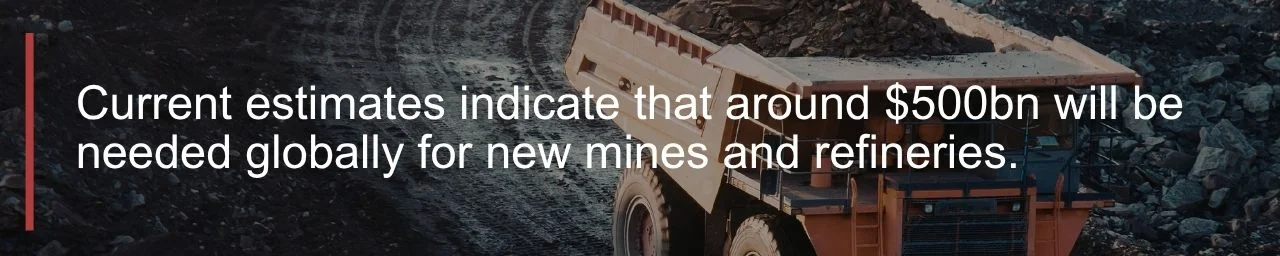
Global critical minerals outlooks by IEA point towards strong long-term growth in lithium, nickel, graphite, rare earth elements (REEs), and copper, with copper alone expected to see material growth as grids, data centers, and industrial electrification expand. Electric vehicles, battery storage and renewable energy projects are driving much of today’s mineral demand, and all three come with significant upfront capital requirements. Current estimates indicate that around $500bn will be needed globally for new mines and refineries under the Stated Policies Scenario (STEPS), rising towards $600bn under faster‑transition pathways.
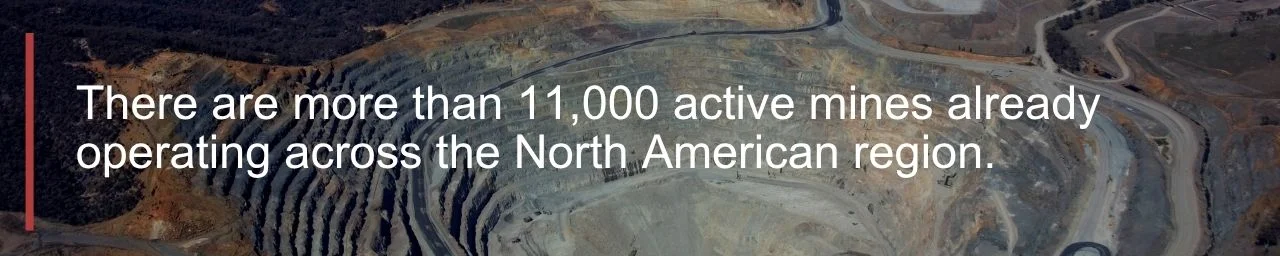
In North America, these pressures are reinforced by domestic investment and industrial policy. Large‑scale infrastructure spending and manufacturing incentives are increasing demand for construction materials, steel and aluminium, as well as battery metals linked to EV and energy storage production. With more than 11,000 active mines already operating across the region, growth is being supported by a combination of existing assets and new investment, while data center build‑outs and grid expansion continue to add pressure to copper supply.
Canada’s mining sector contributes around $40bn to GDP and supports more than 100,000 jobs, with critical minerals positioned as a foundation of future growth. This is reflected in both national initiatives, such as the Green Mining Initiative, and provincial activity, including expanding nickel and cobalt output in Ontario and the development of integrated battery materials supply chains in Québec.
Latin America remains equally important, with the Lithium Triangle of Argentina, Chile and Bolivia accounting for close to half of known lithium reserves, and the region continues to attract a leading share of global exploration spending. Recent joint ventures in Chile and Argentina, including the copper-focused partnership between BHP and Lundin Mining, highlight sustained investment interest across the region.
2. Digital transformation in mining
Digital tools and automation are increasingly showing up in core mining operations, rather than being limited to trials or stand‑alone projects.
In practice, this includes:
- Orebody modelling and geological interpretation using AI‑assisted subsurface data
- Exploration targeting through remote sensing and satellite analysis
- Process control and recovery optimization at plant level
- Predictive maintenance across mobile and fixed equipment
- Autonomous and semi‑autonomous hauling, drilling and digitally controlled processing systems
These technologies are helping operators deal with more complex ore bodies and tighter operating margins. At large copper sites in Chile, AI‑based optimization is already being used to lift recovery, while autonomous haulage is delivering measurable gains in productivity at scale. In the US, Department of Energy “Mine of the Future” programs are also contributing by backing live trials and early commercial deployment.
“DOE is committed to fostering a new generation of skilled miners and equipping them with the tools to lead the world in mineral production and processing technology,” -Assistant Secretary of Fossil Energy, Kyle Haustveit.
Other latest developments include:
- Morenci Copper Mine (Arizona, US) – Freeport-McMoRan is scaling AI-enabled autonomous haulage and ML-based process control to lift copper recovery and extend output from mature assets without major new capex.
- New Afton Mine (British Columbia, Canada) – New Gold deployed North America’s first fully autonomous, battery-electric underground loaders, combining electrification and automation to reduce emissions.
- Côté Gold Project (Ontario, Canada) – IAMGOLD is operating an autonomous open‑pit mining system with haul trucks and drills connected via a central digital control and analytics platform.
- Escondida Mine (Antofagasta, Chile) – BHP is using AI-supported ore body modelling and plant optimization to improve copper recovery, stabilize throughput and support predictive maintenance.
3. Policy, M&A and project funding
Policy and regulatory settings continue to influence mining investment, but there are clearer signs of alignment between industrial priorities and project development than in previous cycles.
In the US, policy around domestic and traceable supply chains is influencing which mining projects move ahead first, particularly those tied to downstream manufacturing, clean energy and defense. Projects classed as strategically significant are seeing faster movement through permitting, while financing is often linked to long‑term offtake agreements or joint ventures. Deal activity has picked up alongside this, with copper‑related transactions featuring heavily.
In Canada, recent changes include the creation of a Major Projects Office to simplify approvals for developments of national importance, including mining. Federal and provincial measures, especially in Ontario and British Columbia, are focused on reducing timelines for critical minerals and energy related projects, with consultation and environmental review brought forward earlier in the process.
Capital deployment reflects this shift:
- Joint ventures are increasingly used to manage capital intensity and risk
- Consolidation is narrowing portfolios around core commodities and regions
- Strategic partnerships are tying miners more closely to end‑users and OEMs
The Anglo American–Teck merger, alongside transactions such as Coeur Mining’s acquisition of New Gold and a series of copper and lithium joint ventures in Chile, illustrate how M&A activity across the Americas is being used to secure scale, streamline portfolios and improve delivery certainty.
4. ESG and community engagement
Environmental and social factors are now built into mining projects from an early stage. Across the region, ESG considerations influence approvals, staffing decisions and how projects are received by investors and host communities.
Meaningful engagement, including workforce plans, upskilling and local hiring, with local and Indigenous communities is increasingly recognized as fundamental to long-term project success, particularly for critical mineral developments located in smaller and remote regions.
In Canada, Indigenous participation is built directly into federal project requirements and feeds through into workforce strategies, governance and procurement decisions. In other regions, operators are focusing on practical changes, including greater use of renewable power, lower‑carbon energy sources, more efficient processing methods and, where it is technically viable, direct lithium extraction to reduce overall environmental impact.
What these trends mean for skills shortages and workforce demand
Skills requirements are starting to change at mine sites and in control rooms. Headcount is increasing, but the experience now needed on-site is also shifting, leading to a shortage in qualified talent available.
In the US, Canada and Latin America, demand is rising for professionals who combine traditional technical expertise with digital capability, including:
- Engineers and technicians able to operate automated and remotely controlled systems
- Metallurgists and process specialists working with AI‑driven performance data
- Geoscientists using advanced modelling and sensing tools
- ESG, environmental and community specialists working directly within operations
Workforce planning to help tackle talent shortages is also starting earlier in the project lifecycle. Teams that align hiring and mobilization with permitting stages, construction activity and commissioning schedules tend to avoid delays once funding and approvals are secured. This is becoming more important as demand for senior and specialist talent increases across multiple regions at the same time.
Where timelines are tight or sites are remote, flexible workforce models are often used, including Employer of Record (EOR) solutions for situations where companies don’t have an established local entity or are entering a new market to deliver a mining project.
Partner with a mining recruitment specialist
With an established presence across the US and Canada, and long-standing delivery capability in Latin America, NES Fircroft is one of the top mining recruitment agencies in the region, combining local expertise with global reach. This local delivery is supported by international talent pools across mining and related sectors, including energy, power and infrastructure. Our teams work close to site and can mobilize specialists compliantly, even where projects are remote, cross-border or operating within complex permitting and community frameworks.
Get in touch today to explore how our expert mining recruiters and compliant talent mobilization services can support your next project.
FAQs
I’m planning a mining project in the US or Canada - how do I choose the right mining focused recruitment agency?
The right mining recruitment partner should understand your region, your commodity, and your delivery timeline. In the US and Canada, look for agencies with proven experience supporting critical minerals, infrastructure-linked mining, and technically advanced operations. With NES Fircroft, you’ll benefit from an agency that can provide local insights, mobilize specialist talent quickly, and support you across project phases.
I need mining staff in Canada – can a specialist recruitment agency help?
Yes. Mining engineers are in strong demand across Canada, particularly those with experience in automation, battery metals and ESG-related work. Using a specialist mining recruitment agency in Canada such as NES Fircroft gives access to engineers who are already familiar with Canadian regulations, site conditions and Indigenous engagement requirements, which helps reduce hiring risk and shorten timelines.
How do I find mining recruitment services that offer strong candidate matching?
The strongest mining recruitment services focus on fit rather than volume. This usually involves understanding the orebody, operating model and workforce requirements before recommending candidates. Specialist agencies provide in-depth technical screening, sector‑specific benchmarking, and talent matched to both your operational needs and long‑term project goals.
What mining technologies should I be preparing my workforce for?
AI‑driven orebody modelling, autonomous equipment, predictive maintenance and integrated control rooms are becoming more common across mining operations in the Americas. As projects are developed or modernized, teams need the skills to work effectively alongside this technology on-site and in control rooms.
If my project spans the US, Canada, or Latin America, how can I manage talent consistently?
Managing mining talent across borders works better with local support. EOR arrangements, compliant mobilization and phased workforce planning are commonly used as projects move through approvals and construction.