What Role is the Middle East Playing in the Global Offshore Wind Sector?
28 Jan, 202610:43Key Takeaways: The Middle East, especially the UAE, has become a major fabrication regi...

Key Takeaways:
- The Middle East, especially the UAE, has become a major fabrication region for offshore wind infrastructure, supplying topsides, platforms and converter stations for European projects.
- Multiple large European offshore wind projects, including Vanguard West/East, BorWin 6, BalWin 3, LanWin 2 and 4 and Ostwind 4, are being fabricated in UAE yards.
- The Middle East’s extensive experience in the offshore oil & gas industry provides a ready-made foundation of transferable skills and infrastructure.
- A growing fabrication market is creating significant demand for specialised talent, making strategic offshore wind recruitment essential for companies operating in the region.
Building the World’s Offshore Wind Farms
The Middle East is now a key part of the global offshore wind supply chain, not through local project development, but through the fabrication of the large-scale assets required for projects overseas. The UAE, along with growing capability in Saudi Arabia and Oman, is delivering platforms, jackets and converter stations for major European offshore wind developments.
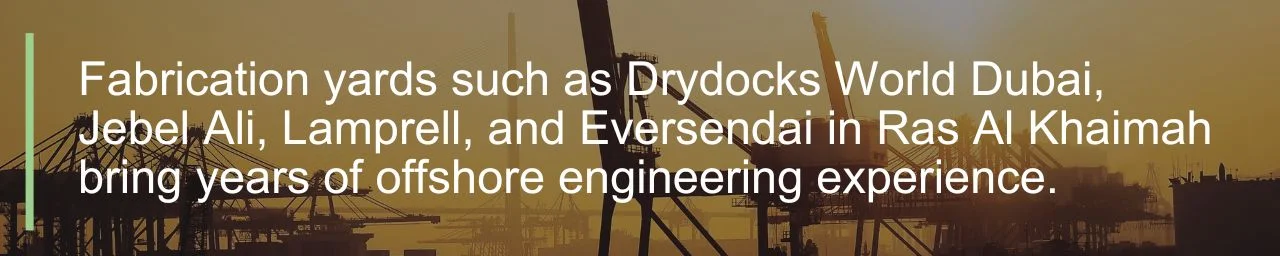
Fabrication yards such as Drydocks World Dubai, Jebel Ali, Lamprell, and Eversendai in Ras Al Khaimah bring years of offshore engineering experience and heavy-industry capability to the sector. This capability reflects a wider industrial ecosystem in the Middle East, shaped by decades of offshore engineering and large‑scale project delivery. The region is supported by deep‑water ports, an experienced workforce and mature supply chains, giving it the capacity to take on complex fabrication programmes.
Current Offshore Wind Projects Being Fabricated in the UAE
The following European offshore wind projects are currently being fabricated in the UAE:
- Vanguard West and East – Fabrication work is progressing through a consortium led by Aker Solutions and Siemens Energy, with topsides and major structures being built in UAE yards before transport to the UK for installation. This follows the consortium receiving full notice to proceed on both projects.
- Balwin 3 – Key elements of the BalWin 3 offshore converter platform are being produced in the UAE, with Eversendai Offshore producing major steel blocks as part of the Dragados Offshore–Siemens Energy consortium delivering TenneT’s 2 GW HVDC programme.
- BorWin 6 – Fabrication activity for the project’s offshore converter platform includes work carried out in McDermott’s UAE yard as part of the wider supply chain supporting TenneT’s grid expansion in the German North Sea.
- Lanwin 2 - Fabrication for the LanWin 2 offshore converter platform has commenced at Eversendai Offshore’s Ras Al Khaimah yard, following the project’s first‑steel‑cut milestone.
- LanWin 4 – Fabrication for the LanWin 4 offshore converter platform is underway in the UAE, contributing to Germany’s HVDC transmission build-out.
- Ostwind 4 – Drydocks World in Dubai is building the offshore platform, following the yard’s award of the project’s fabrication contract. This milestone was confirmed by the company in its latest project announcement.
Why Developers Are Turning to the Middle East for Fabrication
Global developers are increasingly selecting the Middle East for fabrication due to:
- Large-scale fabrication yards capable of handling mega topsides and converter stations
- Deep-water ports suitable for heavy-lift vessels
- Skilled engineering workforces
- Lower fabrication costs compared to Europe, for example
- Decades of offshore oil & gas fabrication expertise
- Timely project execution due to centralised decision-making
The Middle East: More Than Just Sun and Sand
At present, the Middle East’s role in this sector is primarily around the fabrication of offshore wind farms that are then installed in other regions around the world. However, there are other promising reasons why the Middle East’s wind power potential could also increase in the future.
The first – and perhaps most compelling – advantage for the region lies in its geography. While the image of a calm, sun-drenched Arabian Gulf may not immediately evoke thoughts of wind power, the reality is more complex and promising. Certain coastal areas, particularly in the Red Sea and Arabian Sea, possess consistent and strong wind resources that are highly suitable for turbine technology.
The Gulf’s shallow waters also present a significant benefit, potentially reducing the engineering complexity and cost associated with installation of foundations, much like the early successes seen in the North Sea.
Plus, the Middle East’s existing industrial base should not be overlooked. Decades of developing massive offshore oil & gas infrastructure have created a transferable skill set. The expertise in marine logistics, port operations and large-scale project management provides a ready-made foundation upon which an offshore wind industry can be built, offering a distinct advantage over regions starting from scratch.
A Global Comparison
How does the Middle East compare to established offshore wind hubs? It would clearly be misleading to suggest it rivals the operational capacity of the US or China today. However, its value proposition is very different. The region is not constrained by crowded maritime space or the same level of public opposition to wind farms. Instead, it brings immense financial capacity, a strong appetite for technological advances and the ability to make swift, centralised decisions.
In the fabrication space, the region has successfully secured major contracts, demonstrating its capability to rival established markets in Europe and Asia.
The challenge – and therefore the opportunity – lies in building a complete, localised supply chain. This creates attractive new opportunities for not only companies operating in the Middle East but also candidates looking for offshore wind jobs. From fabrication and engineering to project development, marine biology and grid connection specialists, the demand for a skilled workforce is set to rise significantly. For companies looking to grow their presence in the region, this means a competitive marketplace for talent, making effective offshore wind recruitment a critical success factor.
Powering the Transition with the Right Talent
The offshore wind fabrication projects in the Middle East are moving forward with multinational delivery teams and heightened expectations from investors. NES Fircroft has been supporting this market for decades, and our role in the renewables industry has grown in step with the region’s ambition, establishing us as leaders in the field. Our teams have supplied professionals to several flagship projects in the UAE, Saudi Arabia, and Oman, giving us a practical understanding of what successful delivery in this region requires.
NES Fircroft’s specialist teams offer:
- Global mobilisation of renewable energy professionals, supported by our in-region Employer of Record solutions
- Legal and compliance expertise to ensure smooth entry into the Middle Eastern markets
- End-to-end relocation support, helping international workers transition and settle quickly into project roles
- Direct access to highly skilled engineering and technical talent
Projects NES Fircroft have supported in the Middle East:
- Borwin 6 (UAE)
- 2GW Programme (UAE)
- Vanguard East (UAE)
- Vanguard West (UAE)
- Balwin 3
- Lanwin 2
- LanWin 4
- Dolwin 2
NES Fircroft – Partner with the Leading Offshore Wind Recruitment Agency in the Middle East
The Middle East’s growing role in offshore wind fabrication is creating sustained demand for specialist skills. For businesses, it represents an opportunity to gain early entry into a lucrative market. For professionals, it offers the chance to work on high‑profile international projects within one of the world’s most established offshore engineering environments.
While local offshore wind development is not yet planned, the region’s fabrication expertise and industrial base mean that it is well positioned should domestic wind ambitions expand in the future.
Navigating this emerging market requires a recruitment partner with a solid understanding of renewables in the Middle East. NES Fircroft supports fabrication yards, EPCs and developers across the region, connecting them with the talent required to deliver these projects.
Are you looking to build your team in the Middle East? Contact us today for specialised offshore wind recruitment solutions. Also, you can download our free whitepaper titled ‘Expand Your Business Into The Middle East’ for guidance on the legal and workforce challenges of hiring in the region.
Or are you a candidate seeking to advance your career in the region? Explore the latest jobs in the Middle East and register on our portal to apply.
FAQs
How can I secure the right technical talent for wind fabrication projects in the Middle East?
With demand for specialist engineers rising, companies benefit from planning long-term workforce pipelines, using regional and global mobilisation routes, and partnering with specialists at NES Fircroft, who handle compliance, visas and work permits, payroll, and relocation support.
What are the main workforce challenges companies face when entering the Middle Eastern renewables market?
Common challenges include complying with regional labour laws and nationalisation policies, managing cross-border contract structures, and understanding cultural and operational expectations which differ across Gulf countries. Specialist agencies with Employer of Record capabilities in the Middle East can help you mitigate these hurdles.
What should candidates know before relocating to the Middle East for offshore wind roles?
Candidates should be prepared for differences in working culture, rotation patterns, climate and site conditions, accommodation setups, and local norms that may vary from their home country. NES Fircroft provides comprehensive assignment support services to make international moves more manageable.
What kinds of career opportunities are there for candidates as the Middle East expands its offshore wind fabrication capability?
There’s growing demand for site management/ supervision, HSE, welding and coating inspectors, structural engineers, fabrication supervisors, steelwork specialists, quality inspectors, offshore installation engineers, marine logistics personnel and project engineering teams.