Top Data Centre Projects in APAC
03 Feb, 2026

Key Takeaways: North America is entering its busiest decade for large‑scale data center...

Hyperscale demand, AI training clusters, and a wave of private and public investment are recasting where data center facilities get built and how they are powered in North America. Across the United States and Canada, several large-scale builds are setting new benchmarks for size, power strategy, and long‑term regional impact. These projects demonstrate the demand for AI and illustrate how developers are addressing power constraints and complex construction cycles, particularly by ensuring that the right workforce is on-site at the right time.
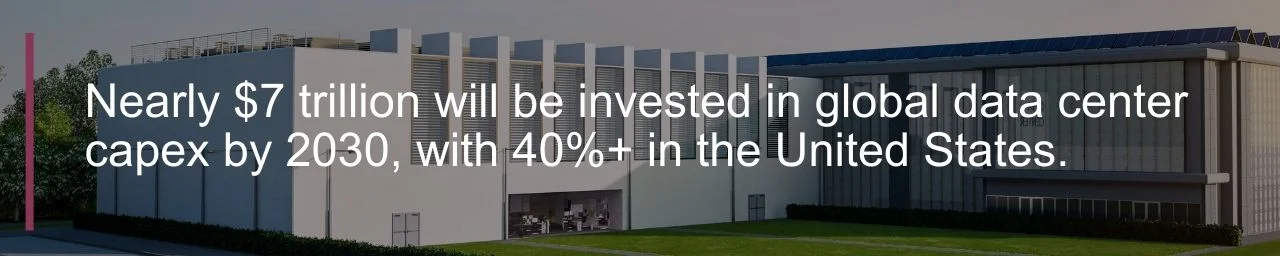
It’s estimated that nearly $7 trillion will be invested in global data center capex by 2030, with 40%+ in the United States, numbers that explain the flood of proposals and the pressure on labor, grids, and planning. But in North America, while growth is intense, it’s also uneven. The primary markets are running with almost no unused capacity left, as many cloud and AI companies are reserving power and space years before new facilities are even finished. In the first half of 2025, around 74% of all space still under construction had already been committed to customers (“preleasing”). Northern Virginia, one of the region’s largest data center markets, saw especially heavy activity, taking on 538.6MW of new demand and growing its under-construction pipeline by 80%.
Behind those headline numbers sit the structural constraints everyone is now wrestling with. Utility queues are swelling, interconnection timelines are slipping, and site selection has become a power first exercise, fueling a push into newer regions that can move quicker on land and energy.
Meta has committed to a 4 millions ft campus in Richland Parish, Louisiana - its largest U.S. site to date - dedicated to AI infrastructure, including training for Llama models. State and company releases describe a long buildout with substantial construction employment (over 5,000 workers) and an energy strategy that includes renewable matching. Meta is pledging to match its full electricity consumption with renewable sources, while near‑term supply will rely on natural‑gas‑backed capacity developed with Entergy to support the high‑density AI workload.
The campus is being positioned to deliver significant economic impact, and that early execution will rely on dependable, fast-moving talent acquisition to keep work on track.
Another high‑profile development is the proposed Stargate initiative, a multi‑state network of AI‑driven data center facilities. Early phase plans center on a flagship site in Abilene, Texas, where one facility is already operational, supported by partners managing land, power, and construction delivery. Expansion plans include additional sites in Ohio, New Mexico, Wisconsin, and Michigan, with total planned capacity approaching 7 gigawatts, underscoring the program’s ambition and nationwide footprint.
On‑site gas turbines are expected to provide a significant portion of the program’s power, demonstrating how developers are increasingly pairing computational growth with localized energy strategies to insulate sites from constrained utility queues.
Google has confirmed a major new $10 billion, 500‑acre hyperscale data center campus in Kansas City’s Northland, internally known as Project Mica. The campus will feature 5 hyperscale data center buildings and represents one of the region’s largest digital infrastructure investments to date.
It will be supported by substantial local incentives and long‑term agreements to ensure reliable power, including Google’s commitment to cover 100% of energy costs under its arrangement with Evergy. The project aligns with Google’s broader acceleration in AI infrastructure spending, as the company’s 2026 capex is projected at $175–185bn, nearly double what it spent in 2025.

In Canada, Alberta continues to draw large‑scale proposals, with Wonder Valley positioned as one of the most ambitious. Developed by O’Leary Ventures in partnership with the District of Greenview, this development spanning thousands of acres will be powered primarily through off-grid natural-gas and geothermal systems. Phase 1 outlines a 1.4‑gigawatt off‑grid power system designed to support AI and hyperscale workloads, with full build‑out projected to reach a multi‑gigawatt threshold.
It’s expected to bring long‑term employment potential, both during construction and ongoing operations, alongside broader regional economic benefits tied to power infrastructure expansion.
A second major Alberta undertaking is the Greenlight Electricity Center. Kineticor and Pembina have announced a ~1.8GW high efficiency, gas fired project (with carbon capture optionality) that’s being advanced in modular phases and explicitly positioned to support Alberta’s growing data center load. The project has moved through early federal assessment, with targeted commercial operation as early as 2029–2030.
Its scale, location, and modularity demonstrate how dedicated energy generation is becoming a central feature of data center planning in regions where operators must “bring their own power” to unlock capacity on competitive timelines.
A Swiss-backed consortium led by Data District Inc. and Technologies New Energy has announced a $1.3 billion phase to develop multiple Alberta facilities, beginning with Olds in 2026 and Bonnyville in 2027, with a longer-term pathway toward ~1 GW of capacity. The Olds campus will generate around 200 indirect jobs during construction and 70 permanent roles by year‑end, growing to 150 permanent positions by 2029–2030.
The selection of Olds reflects a combination of fast go‑to‑market timelines, existing municipal broadband infrastructure, and proximity to Calgary’s logistics network - factors now playing an outsized role in where AI‑focused campuses choose to locate.

With primary hubs straining to deliver continuous power on today’s timelines, secondary and tertiary markets are stepping up. There’s heightened activity in corridors such as Austin/San Antonio, Denver, Salt Lake City, Las Vegas, the Carolinas, and Central Washington, as well as in Canadian markets in rural towns outside of Calgary and Vancouver. These locations offer better odds of securing power, more cooperative land economics, and approvals that move faster.
This doesn’t mean traditional data center hubs are fading. Northern Virginia, Dallas Fort Worth, Phoenix, Chicago, and small towns outside of major cities like Toronto and Winnipeg remain core markets for interest and pipeline activity, but the growth is clearly widening.
The conversation around talent has evolved into one of the most critical factors shaping North America’s data center builds. Across the region, shortages of specialist roles are emerging in construction management, design, commissioning engineering, high-voltage specialties, sustainability teams, and operations staff. These gaps are already influencing project delivery, showing up in longer mobilization windows, compressed commissioning periods, and increased pressure on both schedules and budgets.
Several realities now shape delivery:
What to do next if you’re delivering projects in 2026–2030:

As demand accelerates and competition for specialist talent intensifies, organizations are looking for partners who understand the nuances of data center recruitment. That’s why many operators partner with NES Fircroft. With 15+ offices across North America and a global presence in 45 countries, our teams have decades of experience across every data center environment - whether utility-scale, gas-powered, or renewable-energy-focused - to help clients secure the talent they need, exactly when they need it.
We connect you with professionals seeking data center jobs, giving you the specialist skills needed to keep projects moving and ensure your workforce grows in line with your build program. Contact us today to find out more.
Land availability, reliable access to power, challenges in cooling (liquid), and faster permitting processes are key factors; that's why interest is rising in secondary and tertiary markets where utility timelines, power and water resources, and interconnection processes are easier to navigate.
Onsite generation, long term utility partnerships, and dedicated baseload projects such as Alberta's Greenlight initiative are becoming part of the standard.
Construction and design managers, commissioning engineers, HV specialists, sustainability teams, and operations staff are consistently cited as in short supply across North America's current pipeline.
They shorten the time available for final testing, delay when teams can get onsite, and increase overall project costs, especially when handover dates are already locked in.
Invest in regional upskilling, partner with technical colleges, and work with specialist recruiters who understand compliance, cross-border mobility, and safety-critical trades to see the greatest benefits.