Navigating German Employment Laws: A Complete Guide
23 Sept, 2026


Key Takeaways: Offshore wind recruitment activity in APAC is expanding, but workforce s...


Offshore wind projects in Asia and Australia are moving from early-stage development into large-scale delivery, and with that shift comes a level of workforce complexity that many businesses underestimate. Hiring in one country is rarely the challenge, but when projects span multiple locations, each with its own labour laws, visa systems, and technical standards, that’s when projects can stall or incur unnecessary risk.
(Disclaimer: This blog is for general informational purposes only and does not constitute legal or immigration advice. Always check the latest local rules and professional advice when making compliance‑related decisions.)
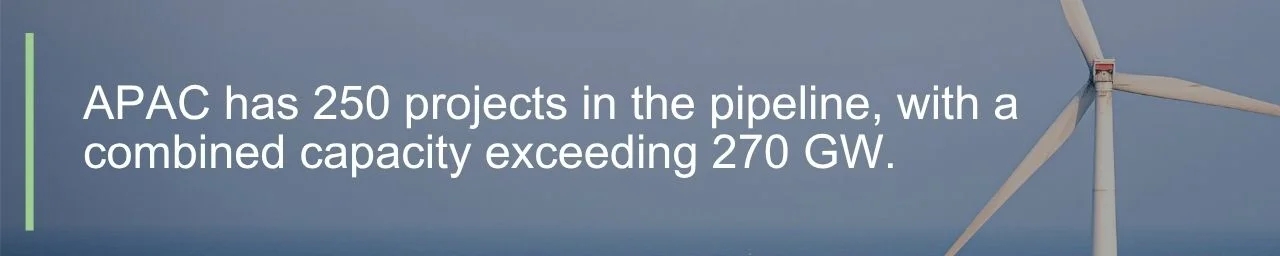
Across Asia and Australia, offshore wind is entering a defining phase. Project pipelines are expanding across Singapore, South Korea, Taiwan, Thailand, Vietnam, the Philippines, Japan, and Australia, with more than 250 projects and a combined capacity exceeding 270 GW currently planned or under development in the region, excluding China, according to EIC’s Insights Report. At the same time, the region is expected to contribute 61% of global wind capacity growth through to 2030, reinforcing its importance in the global energy mix.
Taiwan currently leads installed offshore wind capacity, but Australia holds some of the largest future development pipelines, particularly in Victoria, where offshore wind targets have been formalised alongside large-scale licensing rounds attracting international developers.
However, workforce demand is rising just as quickly. Global projections show that wind technician roles will exceed 600,000 by 2030 as new installations and activity expand. Construction, installation, commissioning, cable installation, foundations, marine operations and long-term operations are all experiencing mounting labour pressure. The challenge isn’t the number of workers required, but how those workers move between regions, meet local standards, and remain compliant throughout the project lifecycle.
Unlike more mature markets such as Europe, APAC projects can span multiple regulatory environments at once. A project might involve fabrication in one country, offshore installation teams from another, commissioning programmes, and specialist contractors mobilised globally. Each step in offshore wind hiring introduces compliance considerations that must be carefully managed; here are the top 5:
Each Asia-Pacific country operates under its own employment legislation, and these frameworks can differ widely in how they treat foreign workers, contractor classification, and payroll obligations.
In Singapore, employers must comply with strict work pass frameworks and quota systems, as well as levies on foreign workers, depending on the sector and role. Thailand enforces a 4:1 ratio of local to foreign workers in many industries, which can directly affect workforce planning. Vietnam’s labour code introduces specific requirements regarding contracts, termination, and worker protections that must be accurately reflected in employment agreements.
For offshore wind projects, this creates several layers of responsibility:
A lot of projects in APAC span multiple locations, with workers moving between fabrication sites, ports, offshore vessels, and substations during a single development cycle. Given this mobility, effective immigration services are crucial to ensuring employees can transition smoothly between locations.
Moving talent across borders is still one of the most difficult aspects of offshore wind recruitment in Asia and Australia. Still, it’s necessary, as many large-scale projects rely on specialised foreign labour. Visa requirements, processing times, and eligibility criteria vary not only by country but also by job type and salary level.
For example, Singapore offers multiple visa categories, such as the Employment Pass and S Pass, each with specific qualifications and salary thresholds. Australia’s Temporary Skill Shortage visa (subclass 482) requires employer sponsorship and labour market testing (LMT). South Korea and Taiwan have their own structured visa systems for skilled foreign workers, often tied to industry demand.
Another broader challenge is that offshore wind projects rarely operate on static schedules. Delays to vessel availability, weather windows, fabrication readiness, or grid connection can all affect mobilisation requirements by weeks or months. So, when immigration approvals can’t move at the same pace, project execution risks increase.
These mobility constraints are becoming a larger industry issue, as global workforce demand increases and projects compete for the same talent pools.
Offshore personnel generally require combinations of internationally recognised safety training, technical certifications, medical clearances, and project-specific qualifications before beginning work, but certifications aren’t always uniform across regions. Some globally accepted certifications include GWO (Global Wind Organisation), BOSIET (OPITO approved), OSHA, IMCA, and G+.
While these provide a baseline, local authorities and project developers may impose additional requirements, depending on:
This creates a need for thorough verification processes to ensure every worker holds valid, up-to-date certifications, meets project-specific and country-specific standards, and can be deployed without additional retraining delays. Developers need confidence that workers arriving hold valid and recognised qualifications before mobilisation begins.
Health, safety, and environmental (HSE) standards are a core component of offshore wind operations, and APAC markets continue to refine and enforce their regulatory frameworks in this area. Companies must ensure that all contractors and personnel comply with national safety regulations, offshore-specific risk management frameworks, and project-level HSE policies and reporting requirements.
Industry data highlights the importance of consistent safety practices, particularly as turbine sizes increase and offshore environments become more complex. Contractor onboarding processes now commonly include competency verification, incident reporting standards, fatigue management, marine safety inductions and more.
Just the same as other renewables sectors, offshore wind is also being affected by digitisation, making cybersecurity requirements more prominent. Modern wind operations rely heavily on integrated IT and operational technology (OT) systems, including remote monitoring, predictive maintenance, and grid integration tools.
This introduces new compliance considerations that you need to be familiar with:
While this area is still evolving, developers are expected to demonstrate that their workforce and systems meet defined security standards, particularly in countries with strict data governance frameworks.
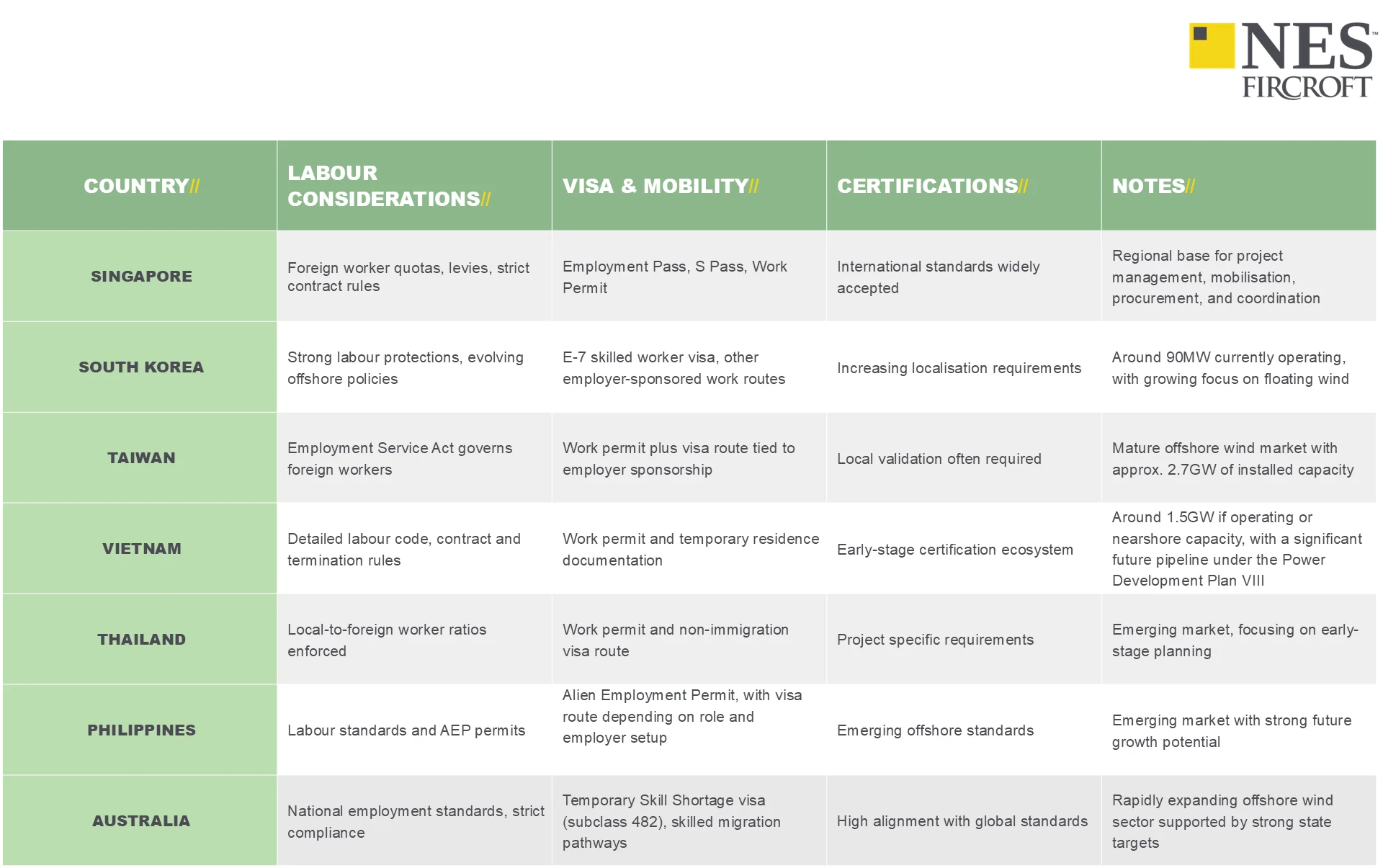
Below is a high-level view of how compliance varies across key APAC offshore wind markets:
NES Fircroft brings more than 5 decades of experience in energy workforce solutions, with a strong track record supporting offshore wind projects globally. We have 29+ locally owned offices across the APAC region, providing local-language support, regional regulatory understanding, and immediate responsiveness for offshore wind developers, OEMs, EPC contractors, and service providers.
Are you currently working on or planning to start an offshore wind project in Asia or Australia? Get in touch with us today to compliantly hire the talent you need.
Developers should focus on employment contracts, worker classification, payroll and tax compliance, visa eligibility and certification verification. Each of these areas varies by country and requires local expertise to be managed effectively.
Start with globally recognised certifications such as GWO and BOSIET, then verify whether additional local or project-specific requirements apply. Working with a recruitment partner, such as NES Fircroft, that manages certification tracking helps reduce risk.
Our immigration services ensure that companies mobilising international workforces have the correct visas and work permits to work and remain compliant in each country where they operate.
Key risks include project delays due to visa issues, financial penalties from labour law breaches, worker misclassification, and safety incidents linked to inadequate certification or training.