Data Centers: How is this Impacting the Energy Mix for Canada?
15 Dec, 20259:24Key Takeaways: Canada has more than 80% of electricity coming from low-emission sources...

Key Takeaways:
- Canada has more than 80% of electricity coming from low-emission sources, helping attract global investment in data centers.
- Hydroelectric power, which provides around 60% of the country’s supply, is central to supporting AI and cloud growth.
- Electricity use from data centers could increase by over 400% by 2050, affecting Canada’s generation and grid planning.
- Ontario, Quebec, and British Columbia lead activity, with Alberta showing growth, but each province faces different challenges around cost, capacity, and clean power access.
- Growing demand for a specialist energy and infrastructure workforce is opening new opportunities for professionals in the sector.
How are data centers reshaping Canada’s energy mix and strategy?
Data centers have quietly become one of the most important parts of modern life, naturally due to the increased adoption of AI-powered applications and cloud computing. These facilities keep these large digital systems running, which are now used globally across different businesses and individuals daily.
In Canada, this industry has also been expanding quickly. There are now more than 230 operational data centers, with the largest clusters found in Toronto, Montreal, and Vancouver. Global technology companies, such as Google, Microsoft, and Amazon, continue to expand their Canadian presence, investing billions of dollars in new facilities, surpassing that of the entire U.S. oil and gas sector in 2023.
The question for Canada is no longer whether this growth will continue, but how it will influence the country’s long-term energy mix and infrastructure planning.
How much power do data centers actually use?
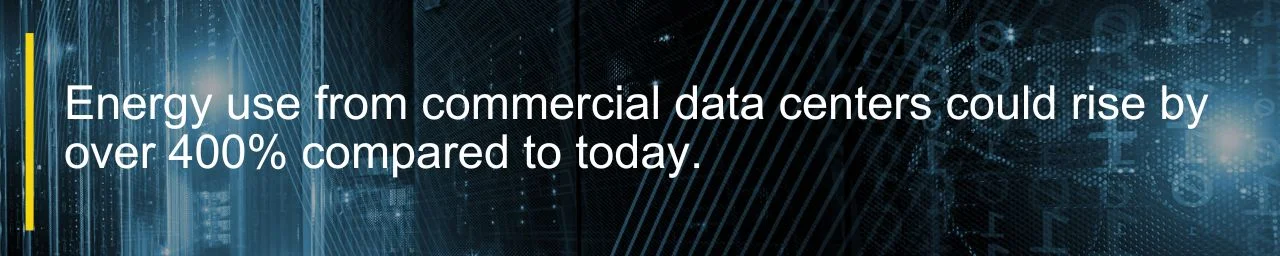
Although data centers currently only make up around 1% of Canadian electricity usage, the AI-driven demand is climbing steadily. The Independent Electricity System Operator (IESO) forecasts that by 2050, energy use from commercial data centers could rise by over 400% compared to today, and this mirrors global trends.
The International Energy Agency (IEA) expects worldwide electricity consumption from data centers, AI, and cryptocurrency operations to double by 2026, surpassing 1,000 terawatt-hours (TWh) annually.
Such rapid growth has implications for both power supply and pricing, particularly in provinces where electricity systems were initially designed for far lower levels of demand.
Can hydroelectric power meet growing digital demand?
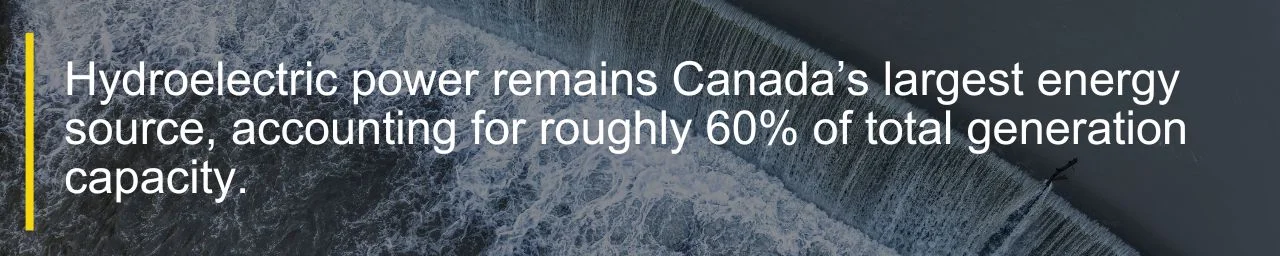
Hydroelectric power remains Canada’s largest energy source, accounting for roughly 60% of total generation capacity. With over 78 gigawatts installed across provinces such as Quebec, British Columbia (B.C.), Ontario, Manitoba, and Newfoundland & Labrador, hydropower gives Canada a strong advantage when it comes to operating low-emission data centers.
Regions with abundant hydro capacity, especially Quebec and B.C., offer some of the world’s most affordable and sustainable electricity. This has made them top choices for companies looking to operate high-performance computing facilities with a smaller carbon footprint.
Still, questions about capacity are becoming more pressing. While hydropower will remain dominant, its share of Canada’s generation mix is expected to decline slightly by 2040 as wind, solar, and natural gas play larger roles. Meeting the combined pressure of digital growth and population expansion will require new investments across the grid.
Will new data center activity drive up power costs?
The answer depends on how well each province manages its grid.
In Quebec and British Columbia, electricity prices have traditionally been low because older hydro infrastructure is already paid for. However, as spare capacity becomes tighter, adding new facilities and transmission lines can result in higher system costs that must be recovered over time.
For provinces like Alberta, where natural gas still makes up a significant share of generation, the trade-offs are different. If future data centers rely heavily on gas-fired power, provincial electricity emissions could double, offsetting the environmental benefits achieved by retiring coal plants (Climate Institute). Another emerging option is the “bring your own power” model, where companies build dedicated generation for their facilities. BitDeer, for example, has acquired a 101 MW site near Fox Creek with plans to construct a natural gas power plant to directly support its data center operations. This approach aligns with Alberta’s proposed Bill 8 (Utilities Statutes Amendment Act), which if passed, will make it easier for data centers to secure independent generation and grid connections.
Furthermore, Power Purchase Agreements (PPAs), such as those available in Alberta, enable companies to purchase electricity directly from renewable energy producers. This provides data centers with a means to stabilize prices, secure renewable energy, and support the development of new wind and solar projects.
The Response from Governments and Grid Operators
Regulators are increasingly focused on balancing growth with responsible energy use.
In Ontario, where data centers could account for around 13% of new electricity demand by 2035, the government introduced new regulations in 2025 that require facilities to obtain Ministerial approval before connecting to the grid. The goal is to prioritize projects that create local jobs, support the economy, and strengthen energy reliability.
Alberta is building two new data centers in 2026, both of which have been allocated power from the Alberta grid, with additional off-grid opportunities. This allocation was made under the Alberta Electric System Operator’s (AESO) interim framework, which capped large load connections at 1200MW through 2028. The two projects approved are the Greenlight Electricity Center, developed by Pembina Pipeline and Kineticor, and the Keephills Data Center with TransAlta.
Meanwhile, IESO continues to plan new supply from wind, solar, hydro, and biofuel through long-term procurement programs designed to keep pace with industrial expansion, including data center development.
These measures demonstrate how provinces are treating digital infrastructure as a significant new energy consumer, one that must be planned for accordingly.
What role will new energy technologies play?
Canada’s future energy mix will likely include a broader combination of hydroelectricity, renewables, nuclear power, and natural gas. Globally, the balance is already shifting. In the U.S., for example, natural gas accounts for approximately 40% of the power used by data centers, but renewables and small modular nuclear reactors (SMRs) are expected to take a larger share in the 2030s (IEA).
Canada is also investing heavily in this transition. The federal government’s $2 billion Sovereign AI Computing Strategy is funding both public and private initiatives to grow the country’s computing capacity. This includes $700 million for new or expanded data centers, $1 billion for public supercomputing infrastructure, and $300 million to make computing power more affordable for SMEs.
Energy innovation will be key to making these projects sustainable. Many Canadian data centers are already using waste heat recovery and advanced cooling systems, helping reduce emissions and energy costs. In addition, batteries, particularly lithium-ion systems, are increasingly being deployed as backup power and to stabilize demand cycles. Data centers are adopting battery energy storage systems (BESS) to provide on-demand support, ensuring continuity when grid operators, such as those in Alberta, require facilities to lower their output during peak demand.
New Demand for Data Center Jobs
The surge in data center development is creating a demand for individuals with the right technical skills. Every new site requires teams of engineers, tradespeople, and operations specialists who can build and maintain highly complex systems designed to run around the clock.
Research by McKinsey suggests that global demand for data centers will rise by 19-22% between 2023 and 2030, with nearly $7 trillion in capital investment. That scale of growth means the creation of new jobs. During construction, a large facility can employ up to 1,500 on-site workers, including R&D engineers, mechatronics engineers, developers, equipment operators, electricians, and renewable energy technicians. Additional positions are created once the facility is operational, with further roles added to the surrounding economy.
Canada’s data center job projection could reach 6,500 over the next four years, including direct, indirect, and induced roles.
As one of the leading data center recruitment specialists, NES Fircroft connects technical professionals with some of the most advanced and sustainable digital infrastructure projects across North America.
Whether you’re a client seeking expertise to scale operations or a candidate pursuing data center roles, our global network and local understanding ensure that the right talent powers Canada’s next phase of digital transformation.

NES Fircroft – Trusted Data Center Recruiters
Canada stands at a pivotal intersection of digital expansion and energy transformation. The rise of AI, hyperscale data centers, and the shift towards renewable energy are converging to redefine the country’s energy mix.
If managed wisely, with investment in clean power, modernized grids, and skilled human capital, data centers can be catalysts for a smarter, greener, and more resilient energy system.
At NES Fircroft, we’re proud to connect expertise with opportunity. Contact our expert team today and find out more about our technical and engineering recruitment solutions in Canada.
Related Posts

Top Data Centre Projects in APAC
03 Feb, 2026