
Giga Ready Workforce Solutions for Renewable Projects
20 May, 202611:10Key Takeaways: Large renewable developments in the Middle East demand more sophisticate...

Key Takeaways:
- Large renewable developments in the Middle East demand more sophisticated approaches to workforce planning, mobilisation, and long‑term capability development.
- Giga‑scale solar, wind, and green hydrogen projects are reshaping skills demand, creating intense competition for specialised talent across engineering, construction, commissioning, and operations.
- Effective workforce strategies for renewable giga projects rely on early planning, compliant global mobilisation, localisation, and structured upskilling.
- NES Fircroft’s experience supporting major programmes, including high-profile hydrogen and solar developments, positions us as a trusted workforce partner.
Renewable energy projects across the Middle East are expanding at a scale that demands new approaches to workforce planning and delivery. Multi‑gigawatt solar, wind, and hydrogen developments are progressing simultaneously, supported by record‑low generation costs, strong national strategies, and a project pipeline that now exceeds 200 GW. The region’s renewable capacity has risen sharply in recent years, driven by innovations in solar PV, wind, and hybrid technologies.
As these developments progress, workforce demand is rising too. The MENA region could create up to 10 million new jobs by 2050 through decarbonisation and green industrial growth. That’s why workforce challenges on giga projects are becoming a central issue and why having an experienced recruitment partner matters.
The Middle East’s Expanding Renewables Sector
A few years ago, hardly anyone would’ve predicted how quickly the Middle East’s energy transition would pick up pace, but now countries across the GCC are competing to deliver the largest solar parks, the most advanced hydrogen facilities, and sophisticated wind developments.
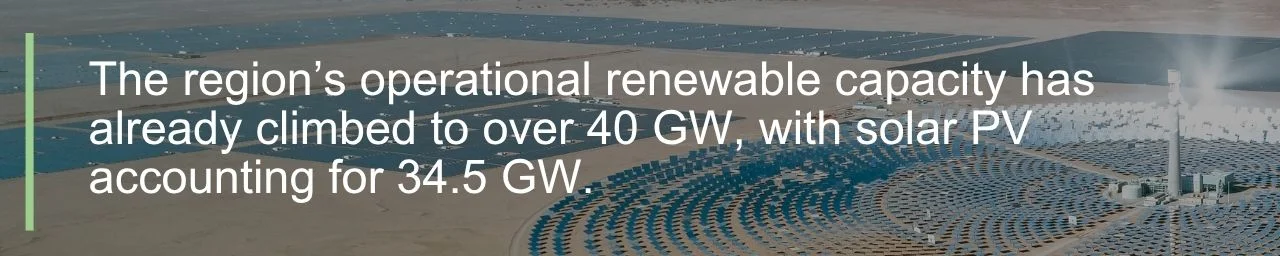
The region has already pushed its operational renewable capacity past 40 GW, with a record 13.4 GW added in a single year. Solar PV makes up a bulk of it at 34.5 GW, supported by wind and CSP technologies, and the combined project pipeline now stands at 202 GW, a figure that has overtaken previous forecasts and sits close to the region’s collective 2030 targets (Dii Desert Energy). Much of this comes down to record‑low generation costs, which have enabled developers to commit to major projects.
The GCC is moving from traditional state-funded megaprojects to integrated, investment-attractive developments that support economic diversification, industrial growth, and human capital development. Saudi Arabia, the UAE, and Qatar remain the top destinations for capital investment in projects.
This momentum has created a surge in demand for specialised talent. 41% of organisations delivering capital projects report shortages of skilled resources as a major barrier to progress, particularly as digital construction, sustainability, and advanced engineering skills become essential (PwC).
The rise of AI‑driven data centres also adds another layer of complexity. Their long-term energy requirements are helping unlock financing for giga-scale renewable developments. But they also require specialised electrical, grid, and high-voltage expertise, skills that are already in short supply. Partnering with a renewable energy recruitment company in the Middle East ensures you can acquire the specialised skills needed for these complex, multi-phase developments.
Flagship Renewable Projects Driving Workforce Demand
Several national flagship projects demonstrate how workforce requirements are evolving across the region:
- Mohammed Bin Rashid Solar Park (UAE) – A multi‑phase solar complex that continues to expand in capacity and technological sophistication to exceed 8,000 MW by 2030, requiring large teams across engineering, construction, and operations.
- NEOM Green Hydrogen Project (KSA) – A globally significant development demanding niche expertise in hydrogen production, electrolysers, high‑voltage systems, and integrated renewable generation.
- PV3 Al Dhafra (UAE) – One of the world’s largest single‑site solar PV installations, contributing to the UAE’s long‑term diversification strategy.
These projects, along with others highlighted in the top renewable energy projects in Saudi Arabia and renewable developments across the Middle East, illustrate the scale of opportunity and the corresponding need for structured workforce planning.
Understanding Giga Project Workforce Challenges
Delivering multi‑gigawatt renewable developments introduces workforce considerations that extend far beyond traditional recruitment. The combination of scale, complexity, and geographic spread creates challenges that require integrated, long‑term solutions.
Skills Scarcity and Market Competition
The region’s shift toward digital construction, advanced engineering, and sustainability‑focused design has created a skills environment where demand outpaces supply. PwC’s survey results show that project management, cost control, commercial management, and engineering design are among the capabilities employers are struggling to secure. And only 29% of organisations have structured digital‑skills training in place, leaving a gap between technology adoption and workforce readiness.
Wider labour trends also add another layer to the challenge. Youth employment in MENA sits at around 25%, the highest globally, and female participation remains among the lowest worldwide (World Bank Group). Even with education levels rising, many young people struggle to transition into meaningful work, leaving a large segment of potential talent underused.
Regulatory and Compliance Requirements
Regulatory frameworks across the GCC are constantly evolving, and localisation policies, visa processes, and employment regulations vary by country. Almost half of organisations say this regulatory complexity contributes to delays and cost overruns. For renewable developers, this means compliance must be embedded into workforce planning from the beginning. To handle this properly, you need a partner that understands the region and can deliver compliant staffing without relying on outside intermediaries.
Remote Site Logistics
Many major infrastructure projects in the region are situated in remote desert locations or along undeveloped coastlines, which places additional pressure on mobilisation, accommodation planning, transport logistics, and HSE management. These conditions have a direct impact on workforce stability and performance. Investing in high‑quality site infrastructure and workforce welfare standards helps attract and sustain both local and international talent.
Technology Integration and Workforce Readiness
Digital transformation is impacting project delivery, with integrated data platforms, digital twins, remote monitoring, and advanced analytics now widely adopted. At the same time, the technologies used in renewable mega‑projects, such as utility‑scale solar PV systems, high‑capacity battery storage, HVDC transmission, and green hydrogen production, require specialised technical expertise that is increasingly hard to source. This creates skills shortages in areas such as solar PV engineering, SCADA and control systems, grid integration, hydrogen process engineering, and digital construction management. Implementing targeted upskilling and reskilling programmes ensures teams can operate and optimise these complex assets and reduce dependence on limited global talent pools.
Best‑Practice Workforce Strategies for Giga‑Scale Renewable Projects
Early Workforce Planning
Effective delivery begins long before construction starts. Early workforce planning allows organisations to map skill requirements, identify gaps, and establish mobilisation timelines. This approach supports cost control, reduces delays, and ensures critical roles are filled before peak activity.
Global Mobilisation and EOR Support
Giga‑scale developments frequently rely on international expertise, particularly during engineering, construction, and commissioning. Employer of Record support offers a compliant route to relocate specialist talent from global markets into the region. NES Fircroft’s EOR services in the Middle East oversee visa processing, payroll, onboarding, and ongoing employment administration, allowing organisations to progress without delays or compliance risks.
Localisation and National Workforce Development
Localisation remains a priority across the GCC, with initiatives such as Saudisation shaping hiring strategies. While international expertise is often required during peak phases, long‑term success depends on developing a strong local talent base. Structured localisation programmes, supported by compliant hiring frameworks, help organisations meet national requirements while building a sustainable workforce for the future.
Upskilling and Long‑Term Workforce Sustainability
As renewable projects become more technologically advanced, continuous capability building becomes essential. Organisations investing in digital‑skills development report faster adoption of new technologies and improved project outcomes. Long‑term sustainability requires a balanced approach that combines international expertise with local talent development and ongoing training. With youth unemployment high and a large segment of potential talent underutilised, structured upskilling pathways and training programmes are even more important, helping organisations attract new entrants, build national capability, and ensure the workforce is prepared for the demands of future renewable giga‑projects.

NES Fircroft: A Trusted Partner for Giga‑Scale Renewable Projects
NES Fircroft has supported major renewable programmes across the Middle East for decades, providing clients with a partner that combines global reach with regional knowledge. With more than 50 years of experience across solar, wind, battery storage, and hydrogen, we deliver fully compliant recruitment, payroll, and mobilisation support without relying on third‑party intermediaries.
Our teams have supported high-profile developments, including major hydrogen and solar projects, and continue to work closely with clients to deliver national flagship projects across the GCC. From sourcing niche engineering talent to managing large‑scale mobilisation programmes, NES Fircroft provides a single, accountable partner throughout the project lifecycle.
To discuss upcoming hiring needs or explore tailored workforce strategies for renewable giga projects, contact us today and speak with our regional teams.
FAQs
What are the largest renewable giga projects currently underway in the Middle East?
Several flagship renewable mega‑projects are underway, including the Mohammed bin Rashid Al Maktoum Solar Park in the UAE, the NEOM Green Hydrogen Project in Saudi Arabia, and Oman’s Manah 1 Solar Project.
What are the best practices for staffing massive renewable infrastructure developments?
Effective staffing requires early workforce planning, compliant mobilisation, structured localisation, and ongoing capability development. Working with an experienced partner ensures that critical roles are filled throughout each project phase.
How can I attract specialised talent to mega renewable construction sites in the Middle East?
Attracting specialised talent requires competitive employment packages, clear career pathways, and strong on‑site support. Experienced partners help streamline mobilisation, improve retention, and ensure compliance with local regulations.
Why work with a recruitment agency specialising in giga projects hiring in the Middle East?
Specialist partners understand the regulatory landscape, skills market, and logistical demands of large‑scale infrastructure projects. NES Fircroft provides compliant, end‑to‑end support, enabling clients to secure the talent needed for complex renewable developments while maintaining operational continuity