How to Hire and Mobilise Teams for Middle East Data Centre Growth
27 Nov, 202615:46The best way to hire and mobilise teams for data centre projects in the Middle East is to pl...

The best way to hire and mobilise teams for data centre projects in the Middle East is to plan backwards from the day the first hall is energised. Each project phase requires different specialists, and each country sets its own workforce rules, so a signed offer only becomes useful once the checks and inductions that follow are complete. Overlapping construction and operations teams before handover then gives a new facility the best chance of opening with people who already know its systems.
Main Takeaways:
- Middle East data centre capacity is on course to quadruple by 2030, with 1.6 GW live today and 2.6 GW in development.
- Plan backwards from energisation, giving each role a lead time based on notice period, accreditation, work authorisation and relocation.
- Combine permanent hires, who hold long-term knowledge, with contractors who cover peaks, and plan each country’s localisation and visa rules as a separate workstream.
- Treat mobilisation as part of the hiring plan. In our case study, a flexible contingent workforce model mobilised 40 commissioning engineers 40% faster, with hiring and operational costs 20–30% lower.
Why Growth Plans Depend on Workforce Readiness
Middle East data centre capacity is on course to quadruple by 2030, according to JLL’s EMEA mid-year 2026 report, which counts 1.6 GW live today with 2.6 GW in development and a further 13.8 GW in the planning pipeline.
The same report also notes that major completions have stalled over the past six months, although developers are deferring schemes and haven’t actually cancelled them, so teams that were planned for one start date may need to be rebuilt around another.
Skilled labour is already under strain across the region, with shortages affecting project delivery in many Middle Eastern markets. Turner & Townsend’s Global Construction Market Intelligence 2026 forecasts Middle East construction cost inflation of 5.1% in 2027, the second-highest of any region, so every unfilled role or slipped start date is likely to cost more than it would have a year ago. Globally, the report finds that the availability of skilled workers now pushes costs up more than materials or supply chain disruption does, which makes labour supply a cost issue as well as a scheduling one. Early, accurate hiring plans therefore protect the budget as well as the schedule.
Anyone responsible for Middle East data centre recruitment needs two answers early in a project. The first is who to hire, and the second is how soon each person can start work on site.
1. Forecast Skills Against the Project Schedule
Skills demand follows the construction programme, so the most reliable hiring plan starts at the energisation date and works backwards, placing each role against the phase in which it first becomes necessary.
This might look like: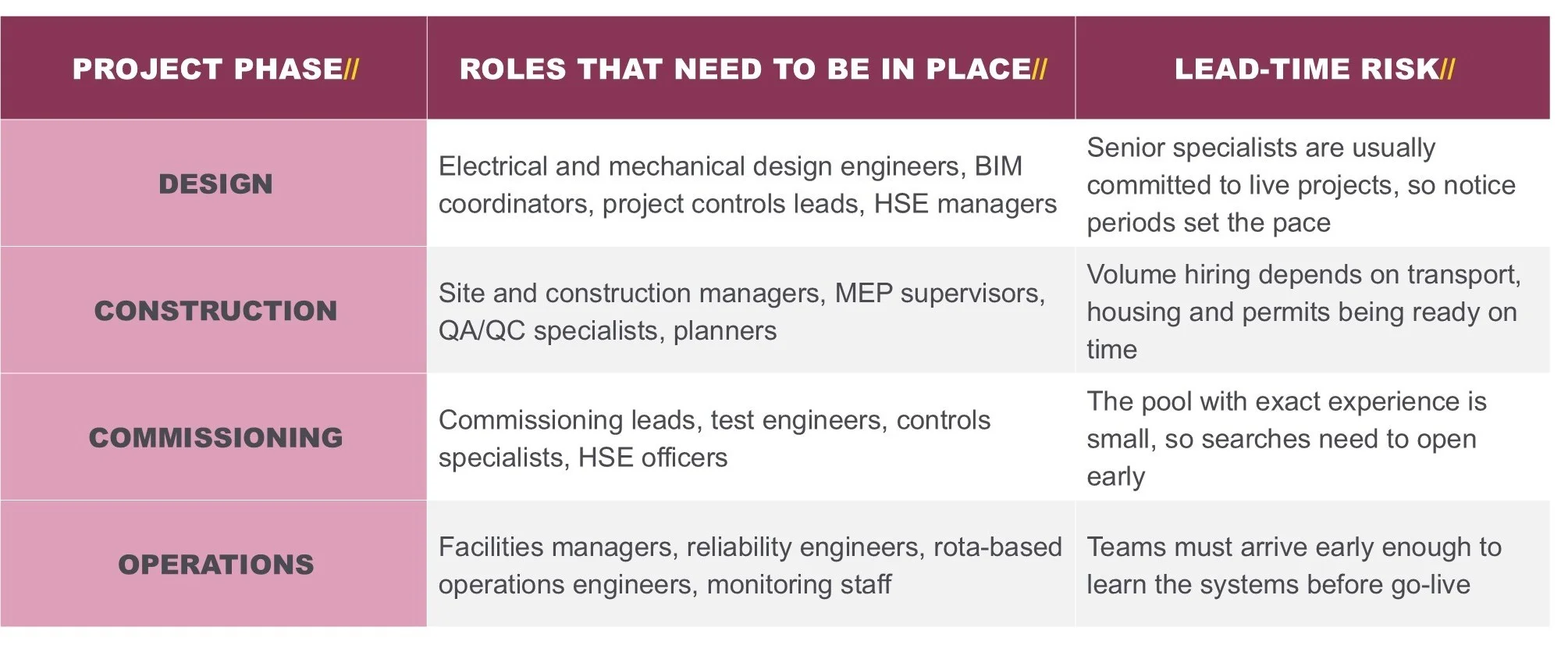
Scarce skills deserve a separate line in the forecast, because a single commissioning lead who’s missing from the programme can hold up testing for every hall that follows.
Each role in the forecast should carry a lead time built from four inputs:
- The notice period a realistic candidate would need to serve.
- Any professional accreditation required before engineering work can begin in the country.
- Work authorisation for candidates moving from another country.
- Relocation, accommodation, and site access.
Roles with the longest combined lead time should go to the front of the hiring queue, even when they’re needed late in the programme, as start dates are the hardest to move once a delay has been spotted.
2. Choose the Right Mix of Local, Permanent, and Project-Based Talent
No single employment route suits every role, so the workforce plan should say which routes apply to which roles and why.
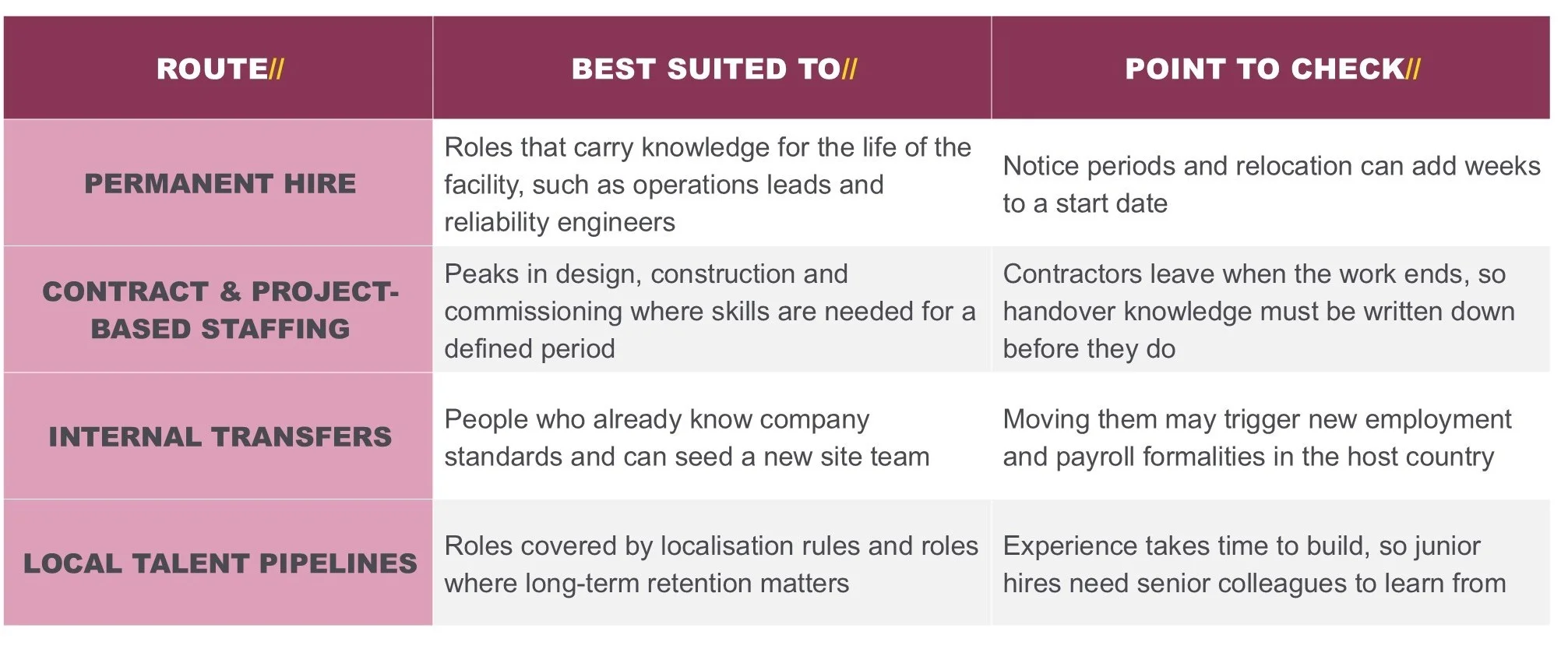
Both permanent hire and contract staffing can be used in the same plan, with contractors covering peaks and permanent hires holding the knowledge.
Workforce requirements also vary by location; for example, data centre recruitment in Saudi Arabia and data centre recruitment in the UAE should be planned as separate workstreams, because the rules differ in both target and method.
Localisation is one example. Saudi Arabia’s Nitaqat programme sets targets for employing Saudi nationals by sector and company size, while the UAE’s Emiratisation rules apply to private-sector employers above a set size, so the roles open to international candidates can differ from one country to the next. Markets such as Oman and Qatar run their own localisation programmes and permit processes, and rules in every country change often. Employment and nationalisation requirements should be checked locally with the employing entity before offers go out.
Visas are another. Work visas in the region are usually tied to a sponsoring employer, so a start date depends on sponsorship, medical checks and documents all being completed in the right order.
See our guide to Employer of Record in the Middle East for more information on requirements in each country.
Case Study: Delivering Commissioning Talent for a Data Centre Project
A global leader in energy management and automation introduced an immediate hiring freeze, driven by regional instability, at a key phase of a major data centre project. To protect commissioning capability without breaching the freeze, we drew on our UAE presence, where we have operated since 2009 as a 100% locally owned international workforce provider, to build a pool of pre-qualified commissioning engineers. We identified over 100 skilled professionals within a tight timeframe and deployed them through a contingent workforce model, with visa processing, medical insurance, transportation and bank account setup handled as part of onboarding.
We mobilised 40 commissioning engineers from India and Egypt during peak demand. Mobilisation was 40% faster, moving from several months to just weeks, and hiring and operational costs were 20–30% lower than with traditional permanent hiring.
3. Assess Candidates for Mission-Critical Environments
Job titles vary widely between employers, so two commissioning engineers can have very different experience; the assessment should test what each person has actually delivered on site.
A short checklist helps hiring managers keep interviews consistent across panels and gives candidates a clear picture of what the project will ask of them.
- Has the candidate worked on a facility with comparable power density and cooling design, and can they describe their own scope within it?
- Can they show test records, commissioning scripts or handover packs that they wrote or signed off?
- Do they have a clean record on energised sites, including experience of permit-to-work systems?
- Can they explain how they logged defects and closed them out before handover?
- Have they coordinated with other disciplines, such as controls and fire safety teams?
- Do they hold accreditation for the country, or a credible timeline to obtain it?
- Do they understand how extreme heat changes cooling design and testing on Gulf sites?
4. Make Mobilisation Part of the Hiring Plan
Mobilisation covers everything from an accepted offer to the first productive day on site, and each step has its own lead time and owner.
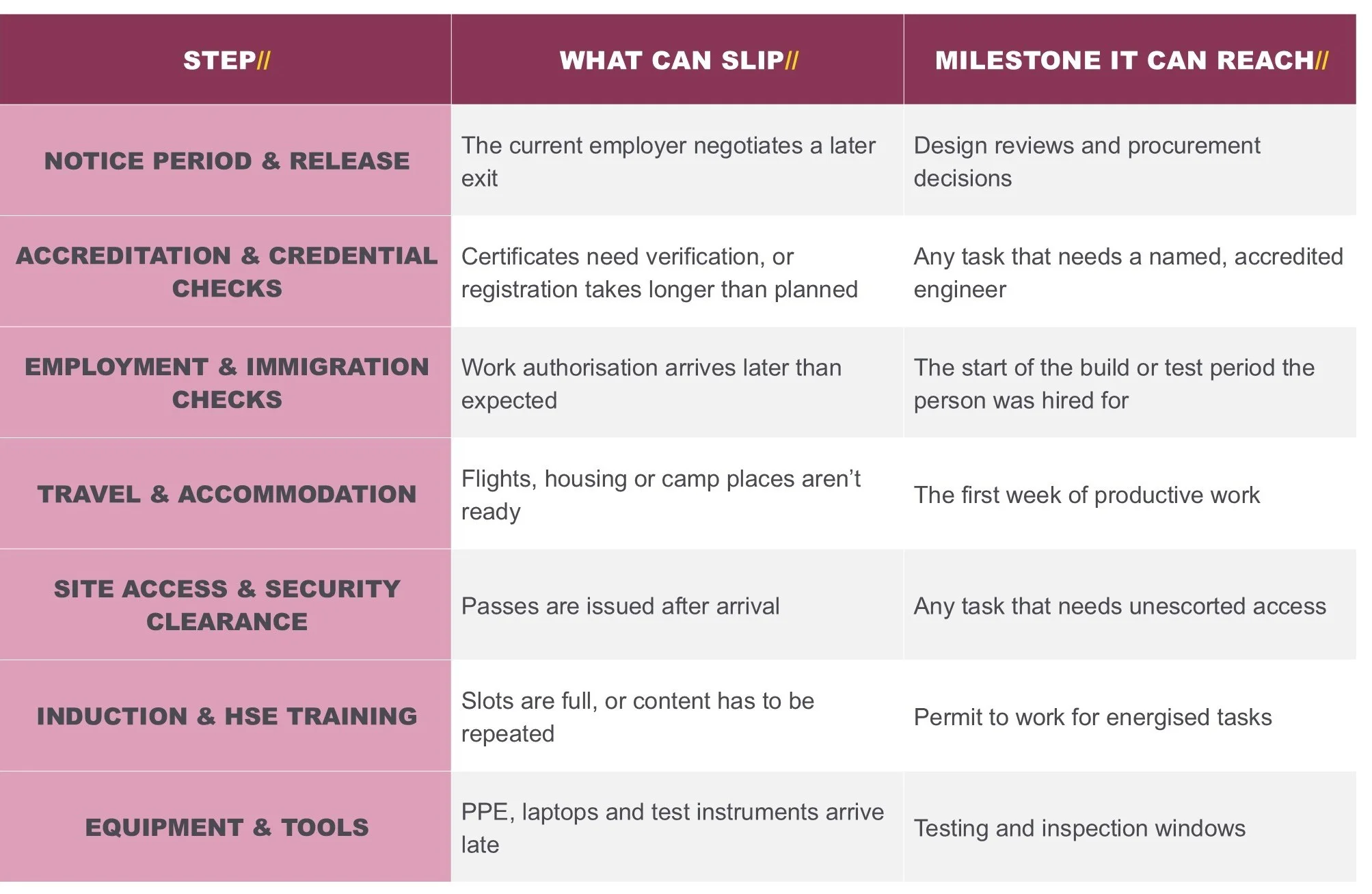
Delays don’t tend to stay within one row of that table, as commissioning tests run in sequence, and a late arrival at one stage can push back the tests for every hall behind it, which in turn delays energisation and the date revenue starts.
The practical answer is to assign an owner and a timeline for mobilisation on the first day of recruitment. Clients who want one partner to own the entire process can request fully managed delivery. Our data centre staffing in the Middle East service operates from 14+ offices across the region and a network spanning 45 countries, with the same teams managing the path from offer to site.
- Employer of Record services in the Middle East let clients hire people in the region without setting up a local entity, with payroll, onboarding and local employment law handled for them.
- Project RPO builds a project-based hiring model around construction milestones and workforce forecasts.
- Assignment support takes on the practical work of visas, travel, and accommodation so that people arrive ready to start.
5. Build the Commissioning-to-Operations Handover into Staffing Plans
Operations teams need to learn the systems they will run before they go-live, and the evidence suggests that time is often squeezed. Uptime Institute’s 2025 outage analysis found that the share of human error outages caused by staff not following procedures rose by 10 percentage points compared with 2024. They suggest the rise may be linked to the industry’s rapid growth and the staff shortages that accompany it, although they describe the cause as unclear.
A staffing plan can reduce that exposure by treating handover as a period with its own team and not a single date.
- Bring operations leads onto site before final testing begins, so they witness tests in person and don’t depend on reports afterwards.
- Hold a recorded walk-through for each major system, with a named person on each site who accepts responsibility for it.
- Keep one shared snag list with a close-out date and a single responsible person for every entry.
- Keep selected commissioning staff available after go-live for an agreed period, so that questions can be answered.
The overlap period is also the most practical time to bring in local engineers to take over day-to-day operations, because they can learn the systems while the people who built them are still on site.
6. Track Workforce Readiness, Not Just Vacancies Filled
A count of vacancies filled says how recruitment is going but says little about whether people will be ready when the programme needs them, so readiness measures belong in the project dashboard alongside cost and schedule.
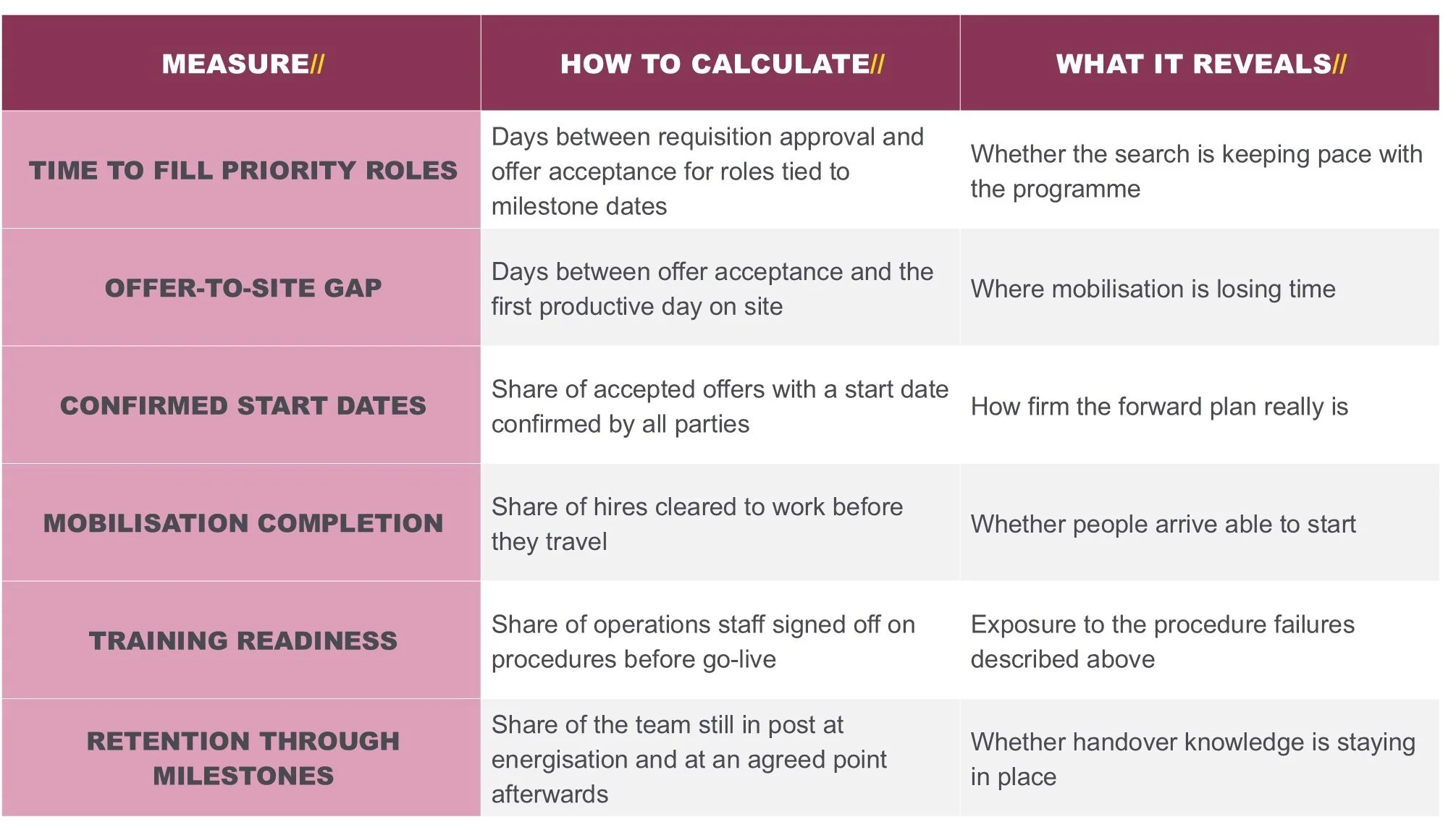
The offer-to-site gap is important to note, as it connects recruitment activity directly to the construction programme, and a widening gap from project-to-project points to a mobilisation step that needs a different owner.
7. Plan Recruitment and Mobilisation Together
Planning recruitment and mobilisation together gives data centre teams a more honest view of their schedule. Projects that forecast skills against the programme and then measure cost get earlier warning when a data is at risk, and more time to respond. Readers who want more regional context can download our Middle East data centre whitepaper or browse our wider data centre insights.
Leading Data Centre Recruitment Agency in the Middle East
NES brings over 15 years of experience supporting developers, EPCs, utilities, operators and hyperscalers across the Middle East's energy, power and data centre sectors. We cover the whole journey from workforce planning and specialist sourcing to mobilisation, through Project RPO, Employer of Record services and assignment support for visas, travel and accommodation. That means clients can staff both project and operational roles with a single partner.
Our local teams work to your programme, whether you need a few specialists for a short commissioning window or support across a multi-phase build.
Planning a data centre project in the Middle East? Contact us today about the specialist talent and workforce support your project may need.
Related Posts

Addressing Talent Shortages in the US LNG Industry
20 Nov, 2026