Addressing Talent Shortages in the US LNG Industry
20 Nov, 2026


When people talk about AI and jobs, they often picture software changing office work. For da...


When people talk about AI and jobs, they often picture software changing office work. For data center developers and operators in the US and Canada, AI presents a more physical hiring problem. Facilities need electricians, commissioning engineers, mechanical and controls specialists, and project managers to turn demanding designs into working infrastructure. Power, cooling and resilience make this an energy and engineering challenge as much as a technology challenge. Projects draw on skills sought by power, renewables and large-scale construction employers. The practical question is whether a developer can find, mobilize and retain the right people when each stage of work needs them.
An AI-ready facility depends on interconnected systems. Electrical specialists deliver power infrastructure; mechanical teams address cooling; controls specialists help systems work together. Commissioning engineers then examine whether installed equipment performs as intended, while project managers coordinate the people and work involved. A gap in any discipline can affect the readiness of the whole facility.
This makes a vague request for “data center engineers” less useful than a brief tied to the actual project. What must be delivered? Which systems will the person own? Who needs their work before another activity can proceed? Answering those questions gives recruiters a clearer search and candidates a clearer picture of the job.
It also changes when recruitment should begin. If workforce availability is considered only after a construction or commissioning program is set, a project may discover that a critical skill is difficult to secure at the moment it’s needed. Data center hiring belongs inside delivery planning from the start.
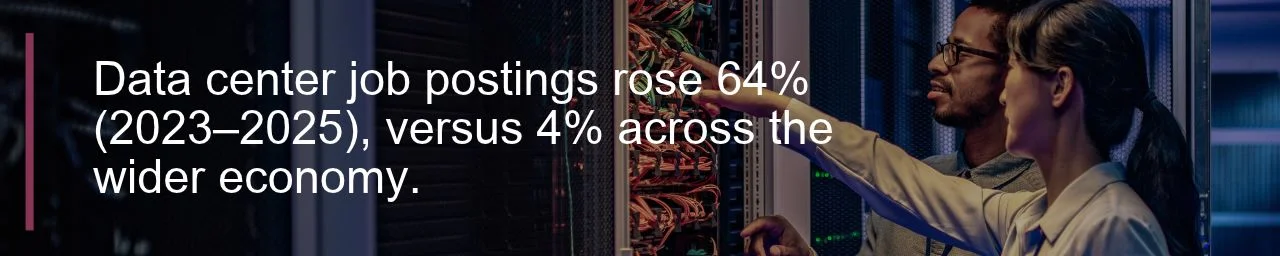
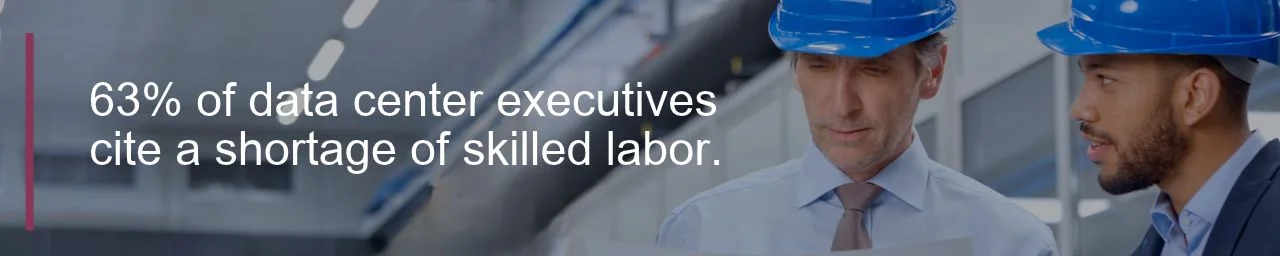
According to Deloitte, between 2023 and 2025, postings for core roles at data center developers rose 64%, compared with 20% at power companies and 4% across the wider economy. Postings for electrical technicians climbed more than 180%, the largest rise among the occupations. And in its 2025 AI Infrastructure Survey, 63% of data center executives cited a shortage of skilled labor.
This shows that data center employers aren’t recruiting from a pool reserved for them. Power, renewables and large-scale construction projects need people with many of the same electrical, mechanical, controls and project delivery skills. A candidate weighing these opportunities is comparing the work itself, not the name of the industry.
The wider construction market is also adding pressure. Associated Builders and Contractors estimates that the industry needs 349,000 net new workers in 2026, with retirements accounting for a lot of that figure, and 456,000 in 2027. The Bureau of Labor Statistics projects electrician employment to grow 9% between 2025 and 2035, much higher than the average. Our guide to data center hiring trends and skills demand covers wages and retention in more detail.
Competition now changes how a role should be presented to candidates. A brief should describe the facility’s engineering challenge, the project stage and the decisions the successful person will be trusted to make and own. It should distinguish an installation role from a commissioning role, or a short project assignment from an ongoing operational position. Otherwise, the search can attract people whose expertise is strong but mismatched to the immediate need.
Employers should also discuss availability before treating a promising resume as a hiring solution. A specialist who cannot join at the relevant milestone may not solve the delivery problem, no matter how well-qualified they are. Recruitment and project teams need a shared understanding of both capability and timing.
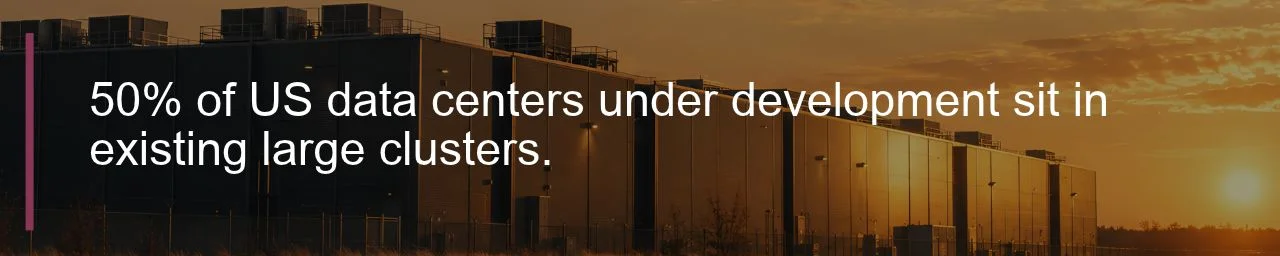
The IEA’s Energy and AI report found that the US accounted for 45% of global data center electricity consumption in 2024, and that nearly half of the capacity is within five regional clusters, including northern Virginia, Dallas, Chicago and Phoenix. It also found that 50% of US data centers under development are in pre-existing large clusters. Projects built close together draw on the same local engineers and electricians, so one developer’s hiring push lands directly on its neighbors.
Sites chosen for power access can face the opposite problem. A location near strong grid capacity may have a small local workforce, which pushes employers to look further afield. Our look at America’s biggest data center builds shows where these projects are landing, and why power access shapes so many siting decisions for AI-ready facilities. Canada follows the same pattern but in a much younger market.
Canada is earlier in its build cycle than the US, which affects how it hires. It's reported that the current AI data center capacity in the region is about 337 megawatts, with more than 20 gigawatts in projects under planning or development. Most of the proposed capacity is in Alberta, where the province has an unofficial goal of C$100 billion in AI data center investment by 2030. The same analysis by TD Economics finds that grid limits in Ontario, Quebec, and British Columbia make large increases in load harder to absorb.
The pipeline lands on a construction workforce that’s already stretched. Labor market pressure is expected to persist in many regions of non-residential construction. Deloitte Canada notes that more than 270,000 construction workers, roughly 15% of the 2024 workforce, will retire by 2034. The shortage of construction workers, electricians and plumbers is one thing that could hold back data center plans.
In-demand roles highlighted by the NES team include:
Alberta is already acting on this. The Information and Communications Technology Council is working with the Government of Alberta on research into data center workforce needs, covering construction trades and engineering roles as well as IT and energy expertise.
Recent conversations between NES and clients point the same way. Canadian operators and developers are looking for experienced people in the US and abroad, and they want specific disciplines to sit alongside project execution. Cross-border moves bring practical questions about work authorization and payroll, and an Employer of Record (EOR) can take on much of that administrative load.
Some of the most relevant candidates may have built their careers outside data centers. Power generation facilities, substations and other critical energy infrastructure projects are examples of environments where reliability, redundancy, and complex electrical systems are part of daily operations. Experience in these settings gives an engineer a useful foundation in continuity and careful testing.
However, transferable experience should still be assessed carefully. Someone who has worked on a general construction project, for example, is not automatically ready for every data center assignment. A better question is what they personally delivered: whether they worked on power or cooling systems, managed interfaces, took part in commissioning or resolved a problem where reliability was critical. Evidence of responsibility is more informative than an industry label.

Widening a search this way gives employers room without weakening the technical brief, and it gives candidates from adjacent sectors a fair way to explain their experience. Data center recruiters can then discuss any familiarization needed instead of assuming that similar-looking facilities have identical demands.
Data center staffing follows the work in front of the project. Construction needs people who can deliver and coordinate installation. Commissioning brings demand for specialists who can test systems, address issues and help prepare a facility for operation. Once it is running, permanent employees can provide continuity and build knowledge of the site.
That is why a contract-led approach can sit alongside permanent hiring. Contract specialists can contribute during defined construction and commissioning periods; permanent roles can support the facility’s continuing needs. The choice should follow the responsibilities and expected duration of the work, rather than a blanket preference for one employment model. NES offers both contract staffing and permanent hire for this reason.
A developer planning an assignment should be clear about its scope, the systems involved and the point at which the work will be handed over. Operational teams need to know what project specialists have tested, what remains to be addressed and where relevant decisions were recorded. Good handovers help preserve the value of temporary expertise after an assignment ends.
Start by placing people alongside the project program. Identify when electrical, mechanical, controls, commissioning and project management input will be required, and which tasks depend on it. Discuss those requirements with delivery leads before a vacancy becomes urgent. The resulting plan should show where specialist assignments are appropriate and where the project needs lasting operational capability.
Next, agree what a candidate must demonstrate. Technical assessment might explore their direct experience of particular systems and their part in testing or resolving an issue. Interpersonal skills matters as well: engineers need to communicate across disciplines, explain decisions and work productively when plans change. A strong technical match who cannot collaborate may struggle on an interconnected project.
Finally, plan mobilization and retention. A suitable person will need a clear start date, an accurate brief and a team prepared to bring them into the work. To keep people engaged, employers should be honest about the assignment and what happens after its current stage. Hiring quickly matters, but a placement that lasts long enough to contribute matters more.

NES brings a cross-sector view to this problem. Its engineering staffing work spans power and renewables, construction and infrastructure, life sciences, IT and manufacturing, alongside other technical markets. This capability allows us to reach people whose relevant experience sits beyond an existing data center workforce.
We have over 15 offices across North America, with new openings expected in Austin and Dallas. Our local teams are backed by a wider global network, which gives clients a market-specific approach in each region.
Our specialized data center recruiters in the US and Canada can place contract and permanent specialists, build a Project RPO program around a build, or hire through an EOR if you have no legal entity in the region where you want to operate. These options let the hiring model follow a project’s changing needs instead of forcing construction, commissioning, and operation into one approach.
Planning to hire for a data center project? Contact our specialist team today.