
How the Mining Workforce Is Changing Across the Americas
06 May, 202611:06Key Takeaways: Mining companies are competing for a shrinking pool of experienced worke...


Key Takeaways:
- Mining companies are competing for a shrinking pool of experienced workers as retirements rise, enrolment falls, and technical requirements increase.
- Labor shortages are structural, with long-term demographic pressures affecting the future workforce in the US, Canada, and LATAM.
- Remote operations, critical minerals growth and digital transformation are changing hiring needs.
- Flexible workforce models, stronger community partnerships and targeted upskilling/reskilling are becoming essential for project development.
Mining companies across the Americas are entering a period in which workforce availability is shaping project feasibility as much as geology, permitting, or capital. The sector is expanding in response to energy security priorities, the rise of critical minerals and the ongoing shift toward lower‑carbon technologies. Yet the labor market is tightening at the same time, and companies in the US, Canada and LATAM are drawing from the same limited pool of experienced workers. These pressures are prompting many employers to reassess how they approach mining recruitment, build capability, and retain the people who keep projects moving.
Understanding the Mining Workforce Pressures
1. It’s a structural shortage driven by retirements and workforce exits
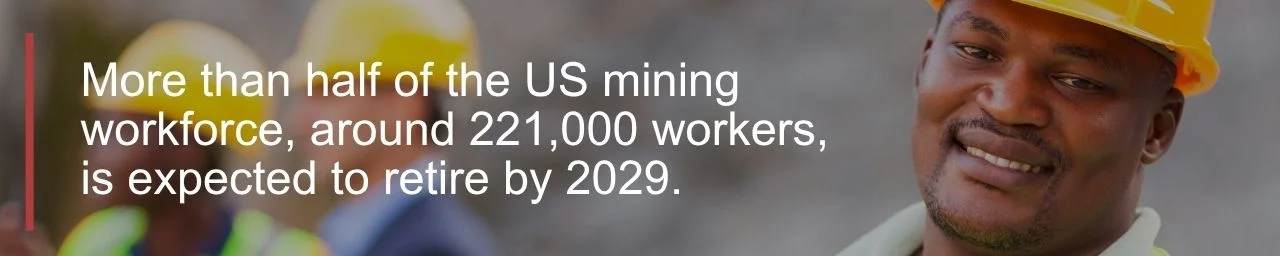
In Canada, the US, and Latin America, the labor market is shaped by demographic shifts rather than short-term demand spikes, with a large proportion of the current workforce nearing retirement. More than half of the US mining workforce, around 221,000 workers, is expected to retire by 2029, and operators struggle to fill technical roles while employees leave faster than organizations can train replacements. Canadian labor market forecasts highlight that retirements and industry exits are rising, with MiHR projecting an average exit rate of more than 2% per year through 2034.
Large-scale copper, lithium, and nickel projects in Chile, Peru, Argentina and Brazil are expanding, and these developments compete directly with North American operations for experienced engineers, supervisors, maintenance specialists and project delivery talent. The result is a continental talent squeeze that affects every stage of the mining lifecycle.
2. Declining enrolment and entry of young workers
Fewer young people are entering mining-related fields, even though the sector is generally well paid. It isn’t attractive to Gen Z, who have higher expectations for purpose at work. The Mining Association of Canada highlights a significant decline in engineering graduates across geological, metallurgical and mining disciplines. In the US, mining-related degrees have dropped sharply, with a 39% decline in mining graduations since 2016, creating a replacement challenge as the majority of the workforce reaches retirement age.
This combination of fewer entrants and more exists is one of the most significant mining workforce challenges facing the region.
3. Critical minerals growth is intensifying competition
The Americas are central to global critical minerals supply. Canada’s national strategy emphasizes the need for new mines, smelters and refineries to meet rising demand for graphite, lithium, cobalt, and nickel. The US is pursuing similar goals, with federal initiatives supporting domestic supply chains, and LATAM remains a global powerhouse of copper and lithium.
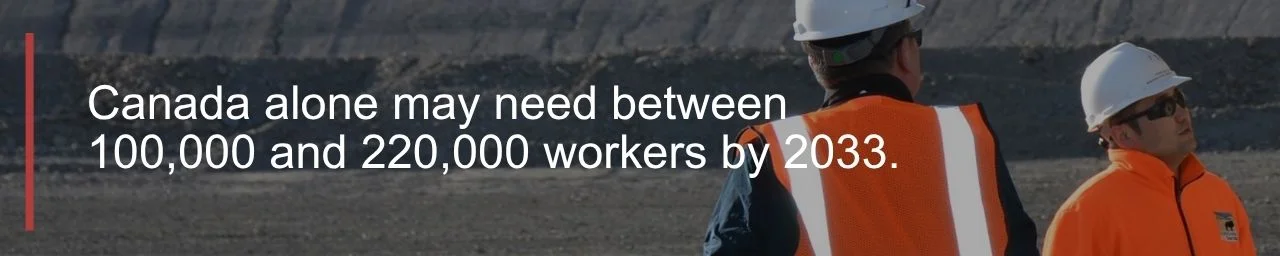
This growth is creating new jobs, but it’s also amplifying existing shortages already seen within the mining sector. Canada alone may need between 100,000 and 220,000 workers by 2033 to replace retiring workers and support new development. The industry is also experiencing a digital transformation as mine sites and operations become more sustainable and efficient, making AI fluency and advanced technical skills baseline expectations for workers, further pressuring the talent pipeline.
Suggested Read: Top Mining Trends to Watch in the US, Canada and LATAM
4. Remote locations add complexity
Many of the most active mining regions in the Americas are remote. In the US, states such as Nevada, Alaska, Arizona and Wyoming lead production, yet these locations can be challenging for workers to relocate to. Canada faces similar issues with many operations located near northern or rural communities, and LATAM projects often require rotational schedules or extended travel, which can deter younger professionals.
5. A changing skills mix
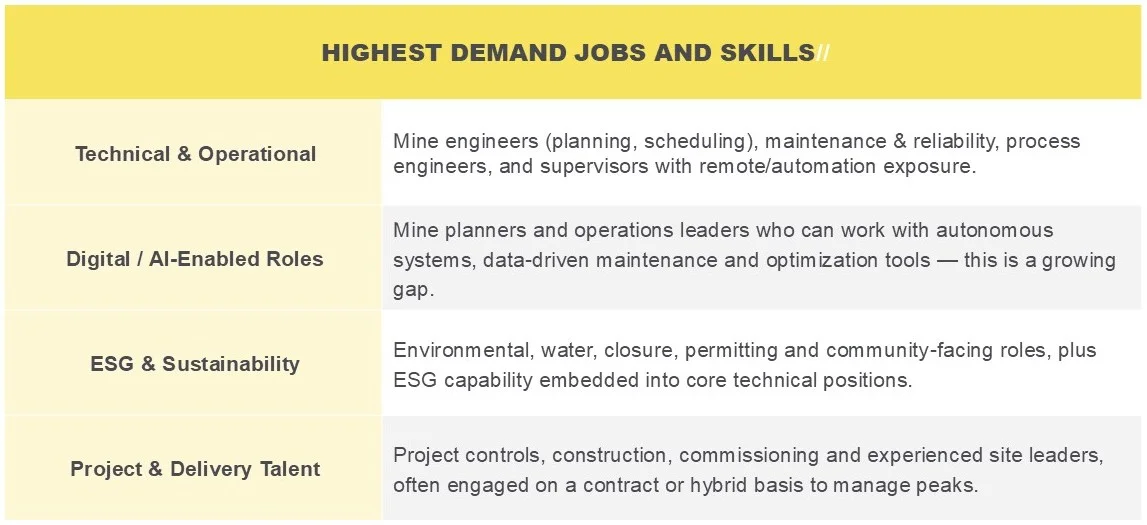
The skills required in mining are evolving as new environmentally friendly technologies emerge, with automation, digital maintenance tools, and data-enabled planning becoming standard across operations. Deloitte’s outlook suggests that AI literacy may soon be a baseline requirement for many mining roles. We’re seeing rising demand for mine planners, operations leaders, and maintenance specialists who can work with autonomous systems and optimization platforms.
ESG-related roles, such as environmental specialists, water management experts, permitting professionals, and community-facing teams, are also increasingly embedded in core operations. This change is particularly visible in Canada and states such as Alaska, where environmental stewardship and Indigenous engagement are central to project development.
How You Can Respond to These Workforce Challenges
- Strengthen talent pipelines through education and community partnerships: Many companies invest in early education, scholarships and partnerships with community colleges and technical institutions. These initiatives help build awareness of mining careers and support the development of essential skills. In Canada, programs such as the Sectoral Workforce Solutions Program and Indigenous Skills and Employment Training Program are helping to build “mineral literacy” and prepare workers for critical minerals roles (IEA).
- Build a more inclusive workforce: Another way to tackle the shortage is to diversify your workforce, especially as women, young workers and visible minorities are underrepresented in many parts of the industry. The Mining Association of Canada highlights that increasing participation among these groups is essential for meeting future labor needs. Indigenous employment remains a strength in Canada, with more than 12,000 Indigenous workers in mining and quarrying, but there’s still room for growth.
- Adopt flexible workforce models: Contractors, rotational workers and mobile specialists are essential for managing peaks in project activity. We see strong demand for project controls, commissioning, construction and site leadership talent on a contract or hybrid basis. These models help companies maintain progress even when local talent is limited. You can also benefit from solutions such as Employer of Record, which simplifies cross‑border hiring and supports mobility across the US, Canada and LATAM. Companies that are leaning into workforce flexibility are moving faster than those relying only on local permanent hiring.
- Improve retention through better EVP: Younger workers are seeking purpose, development and stability. Many want to see how their work contributes to sustainability and innovation. Companies that articulate a clear employee value proposition (EVP), invest in training and provide pathways for advancement are more likely to retain skilled workers. High wages remain a draw, particularly in remote regions, but long-term retention depends on culture, development, and work-life balance.
NES Fircroft: Partner with a Specialist Mining Recruitment Agency
We’ve been supporting mining projects in North & South America for over 20 years, supplying technical and engineering talent to operations in the US, Canada, and LATAM. Our global footprint and in-house visa function enable us to mobilize specialists from leading mining regions worldwide, strengthening local workforces and helping you scale quickly. We have offices in key mining regions, so our teams can provide on-the-ground support with permanent, contract, compliance, or global mobility solutions for your mining workforce.
With local and global experience supplying geology, engineering, maintenance, operations, and project delivery talent, along with expertise in adjacent areas such as power and renewables, we can help you build dependable workforce strategies across diverse locations and project types.
If you’re planning upcoming projects or need support with your current workforce strategy, our mining recruitment specialists are ready to help - contact us today!
FAQs
What strategies help attract skilled labor to remote mine sites?
Improve accommodation, offer rotational schedules, invest in community partnerships, and highlight career development opportunities. You can also use mobility support and contractor models to widen the talent pool. NES Fircroft provides flexible workforce structures that help projects progress in remote regions across the US, Canada and LATAM. More guidance is available in our article on hiring for remote mining sites.
What are the top workforce challenges mining companies should plan for next?
Mining companies face long-term talent shortages due to an aging workforce, declining enrolment in mining‑related programs, rising technical requirements, remote project locations and growing demand for critical minerals. These pressures make proactive workforce planning essential. Companies that map future skills needs, build early-career pipelines and partner with workforce specialists will be better positioned to secure talent ahead of demand.
How can mining companies improve retention and reduce turnover?
Retention improves when companies strengthen their EVP, invest in training, support career progression and create inclusive workplaces. High wages help, but long‑term loyalty often depends on culture, development and work‑life balance.
How can I strengthen my mining recruitment strategy?
You can partner with a mining recruitment company to access wider talent pools, streamline hiring and support mobility across borders. With demand for raw material mining rising across the Americas, many now need to source talent globally from mining hotspots where skills are transferable to US or Canadian regulations. NES Fircroft’s in‑house visa team works with our global recruiters to bring niche skillsets into the US, Canada and LATAM, helping clients secure hard‑to‑find technical and leadership talent when local supply is tight.