How Canadian Mining Companies Are Recruiting for Critical Minerals Projects
19 Nov, 202611:02Canadian mining companies are recruiting for critical minerals projects by building their ow...
Canadian mining companies are recruiting for critical minerals projects by building their own talent pipelines with schools, apprenticeships and industry bodies such as MiHR. They’re also attracting workers from other provinces and neighboring sectors, involving Indigenous communities from the planning stage and bringing in international specialists when local supply runs out. Many also work with specialist mining recruitment agencies in Canada to reach passive candidates and fill technical roles before schedules.
Main takeaways:
- Critical minerals made up 33.4% of Canada’s mineral and mining sector in 2024, and the jobs attached to them keep multiplying.
- Natural Resources Canada expects the industry to need more than 191,000 new workers between 2024 and 2034.
- Employers are investing in education and graduate schemes before mines open.
- Interprovincial moves, rotational rosters and Indigenous partnerships are part of standard recruitment planning.
- International specialists fill the roles that domestic searches cannot.
Why Canada’s Critical Minerals Projects Are Short of Skilled People
Canada is at the center of the global critical minerals supply chain. PDAC reports that 75% of the world’s mining companies are headquartered here, and the country is among the top 10 global producers of aluminum, cobalt, lithium, and nickel. Batteries, wind turbines, photovoltaic panels, satellites, and data centers all depend on the metals found on Canada’s critical minerals list.
Public funding follows the demand. The federal government has put $3.8 billion behind the Canadian Critical Minerals Strategy, and there are other tax incentives to encourage more growth in the sector, such as the Canadian Mineral Exploration Tax Credit, which gives investors in exploration companies a 30% credit on the amount they put in. The IEA estimates that mineral demand for clean technologies will be two to six times higher by 2040 than it was in 2020.
Mines need people, though, and that is where the pressure is becoming visible. Around 20% of the current workforce is over 55, so retirements will take experience out of the industry just as new projects need it. We’ve already covered the wider workforce challenges in Canada’s mining talent shortage here.
What Are the Major Upcoming Critical Minerals Projects in Canada?
Canada’s list of priority minerals feeds three value chains in the national strategy. Clean technologies, including batteries and permanent magnets, sit beside advanced manufacturing and communications technology. Lithium, nickel, graphite, cobalt, copper, and rare earth elements (REEs) attract investment because each one is hard to replace in those chains. Gold doesn’t appear on the federal list, but many projects in the region also focus on this mineral.
Ontario and Quebec carry much of the nickel, graphite and lithium activity, while Saskatchewan’s potash earns it a place among the top GDP contributors. Individual provinces have also published their own critical mineral strategies, which provide useful context for any employer deciding where to base a hiring push.
Three Canadian critical minerals projects show how varied the demand is:
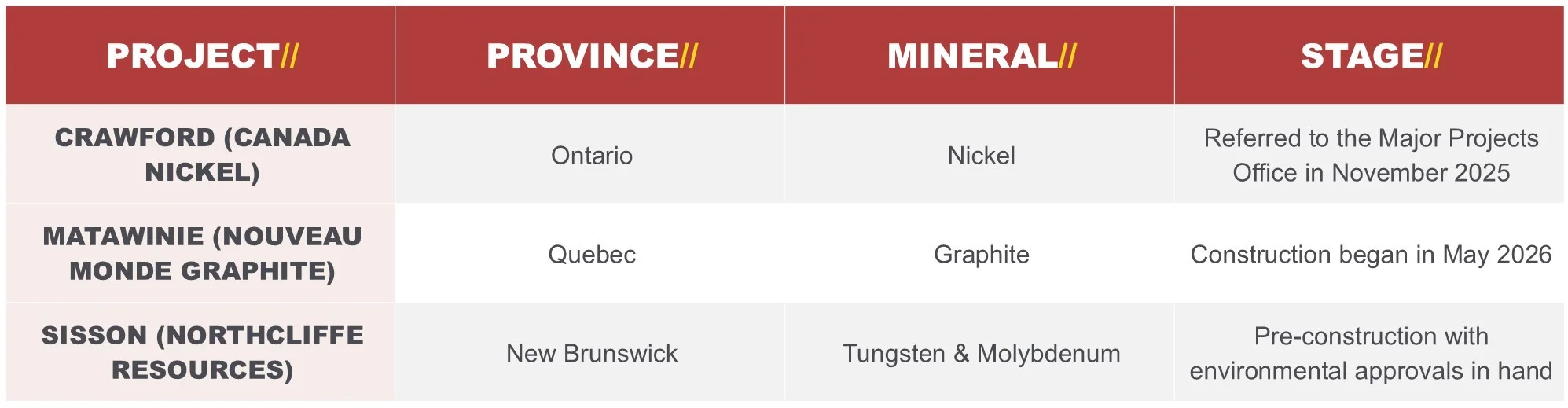
Crawford is located in Timmins, Ontario, and Mining Weekly reported its referral alongside Matawinie and Sisson. Construction at Matawinie started six months after its referral, which is a short gap for a mine of that size. Sisson is also important to note, as Canada hasn’t produced tungsten since its last mine closed in 2015, so the workforce will be rebuilt from a much smaller base.
Each project stage pulls from a different profile. A project under construction needs people to build and commission, a project in permitting needs environmental and engineering planners, and an operating mine needs maintenance and processing teams for decades. Employers generally plan for all three at once, and that’s why mining employment in Canada is hard to forecast from one project alone. Statistics Canada found that jobs tied to extracting and producing critical minerals grew 5.4% in 2024 to nearly 57,500, while the minerals sector as a whole directly employed 438,000 people.
Which Skills Are Hardest to Recruit for Critical Minerals?
We asked our Canadian mining team which two to three roles they’ve found hard to fill in critical minerals searches right now, and why. Here are the top ones:
- Metallurgists and Senior Metallurgists remain among the most in-demand professionals in the mining sector, with demand significantly outpacing the available talent pool.
- Mining Engineers at all levels, particularly Senior, Principal, and Chief Mining Engineers, are highly sought after due to a shortage of experienced technical leadership across the industry.
- Geologists with proven experience in lithium, nickel sulphide, and rare earth mineral deposits are in particularly high demand as critical minerals projects continue to expand across Canada.
How Mining Companies Are Building Talent Pipelines
Training a welder, a geoscientist, or a mine planner takes years, so waiting for a project approval before hiring leaves little room.
Industry bodies already provide a range of support on this to build local workforce capability. NRCan funds Mining Industry Human Resource Council initiatives such as the Mining Ambassador Program, the Mining Career Seeker Dashboard and the National Youth Mining Career Awareness Strategy. An earlier federal project, the Mining Sector Skills and Solutions Strategy, delivered 416 work placements and scholarships for 643 students. Employers who connect with MiHR gain direct access to people already interested in the sector.
Our view is that the strongest pipelines combine several entry points. Partnerships with colleges and universities supply graduates, apprenticeships grow trades talent on site, and graduate programs keep early-career engineers and geoscientists from drifting into other industries. Flexible arrangements, such as short contracts and project-based roles, then cover the gaps while those pipelines fill. Companies planning construction in 2027 or 2028 are already building these relationships because the people they need are still training.
Where Are Employers Sourcing Talent for Critical Minerals?
Established mining regions can’t cover every new project, so employers are looking wider. The One Canadian Economy Act removes federal barriers to interprovincial trade and labor mobility, which makes it simpler for a Saskatchewan or British Columbia professional to take a role in northern Ontario or Quebec. Employers who once hired only within the province in which they operate can now advertise roles nationally much more easily.
Adjacent sectors are the next pool, as traditional oil and gas workers, power generation specialists and civil construction workers hold many technical and safety credentials a mine requires. Emerging talent markets can also contain people who’ve never worked in mining but can learn quickly with the right induction.
Many critical minerals deposits also sit far from large towns and are often in remote locations, so rotational rosters, with workers flying in for a set block and then returning home, let employers hire from a much larger area than the local population allows.
Finally, Indigenous participation deserves its own place in your recruitment plan. The Canadian Climate Institute found that 69% of active mines, including projects in development, lie within 50km of federally recognized Indigenous territories. The report argues that Indigenous rightsholders should be involved throughout a project’s life, from exploration to reclamation. For recruitment, that means local hiring and training commitments belong in the earliest workforce plans. Federal programs such as the Indigenous Natural Resource Partnership Program exist to help communities benefit directly.
Can International Talent Help Fill Critical Minerals Skills Gaps?
Sometimes the Canadian market simply doesn’t hold enough people with a particular specialism. International recruitment fills those roles, and critical minerals employers use it selectively for senior technical positions or niche roles that might need to be sourced contractually elsewhere to meet urgent project demands.
Canada’s Global Skills Strategy exists for this purpose. It’s designed to speed up work permit processing for highly skilled foreign workers, which suits project teams with firm construction dates. Candidates from countries with mature mining industries, such as Australia, often arrive with experience that’s scarce locally.
In instances like this, where global expertise is required, an Employer of Record (EOR) can simplify hiring and compliance, ensuring international talent is onboarded and relocated correctly. This is especially useful for companies with no legal entity in the project location, e.g. an Australian company working on the construction phase of a mining project in Quebec can transfer specialists there through an EOR without setting up a Canadian entity. This shortens the timeline and lowers costs.
Our article on moving Australian talent to Canada through an EOR covers the route in detail, and our EOR services page explains how we employ workers on your behalf while immigration paperwork is processed.
Your Partner for Mining Recruitment in Canada
Companies don’t struggle because they lack a hiring plan, they struggle because the workers they want are already employed or aren’t browsing job boards. A specialist mining recruitment partner closes that gap by spotting talent shortages, approaching passive candidates directly, organizing the travel and onboarding that rotational and relocated hires need, and finding technical expertise that a general recruiter wouldn’t know how to look for.
NES recruits across the entire mining sector and has worked with employers throughout the country for over 18 years. Our mining recruitment team in Canada understands how critical minerals projects differ from established operations, and our wider services provides global reach when a role needs an international search.
If your critical minerals project needs engineers, geoscientists, tradespeople, or project leaders, get in touch with us today.
Related Posts
Highlights from Yotta 2026 and the Race to Power AI
22 Oct, 2026