Navigating German Employment Laws: A Complete Guide
23 Sept, 2026


To stay compliant with European labour laws in multi-country projects, businesses should bui...


To stay compliant with European labour laws in multi-country projects, businesses should build workforce compliance into project delivery from the outset and use country-specific expertise when deploying staff across borders. In life sciences CapEx projects, specialist engineering, commissioning, and validation teams often move between locations during different phases of a build, making workforce mobilisation a project consideration as much as a legal one. Reviewing employment requirements early and adopting specialist workforce solutions to manage local obligations helps keep projects on schedule while reducing administrative complexity.
Europe’s life sciences sector is expanding again, and at pace. Pharmaceutical companies invest an estimated €55 billion a year in EU research and development, supporting around 2.3 million jobs across the region. Similarly impressive, venture capital into European life sciences reached €13.2 billion in 2025, representing a 2.8% increase on 2024.
Much of this growth is being driven by manufacturing itself, not just research. Pressure to near-shore production, concerns around supply chain resilience and support via EU policy initiatives, such as the Critical Medicines Act, are all pushing biopharma and biosimilar production back onto European soil.
For project leaders managing CapEx builds in Europe, this growth creates an opportunity but also practical problems. First, the requirements for delivering a GMP- or GxP-compliant facility differ greatly from one country to the next. And second, all of those projects need a highly skilled workforce. So, specialist engineers, validation experts and commissioning teams often need to move between projects in different markets like France, Germany, Belgium and Ireland.
Moving people across borders sounds straightforward in principle. But in practice, each country attaches its own rules to pay, contracts, working hours and worker representation. Workforce compliance is often one of the most under-estimated risks in any multi-country CapEx recruitment strategy.

The complexity is not accidental. Every country – even individual EU member states – has built its employment framework on its own legal tradition and history of worker protection. So, what counts as compliant in one country can be a serious breach in another.
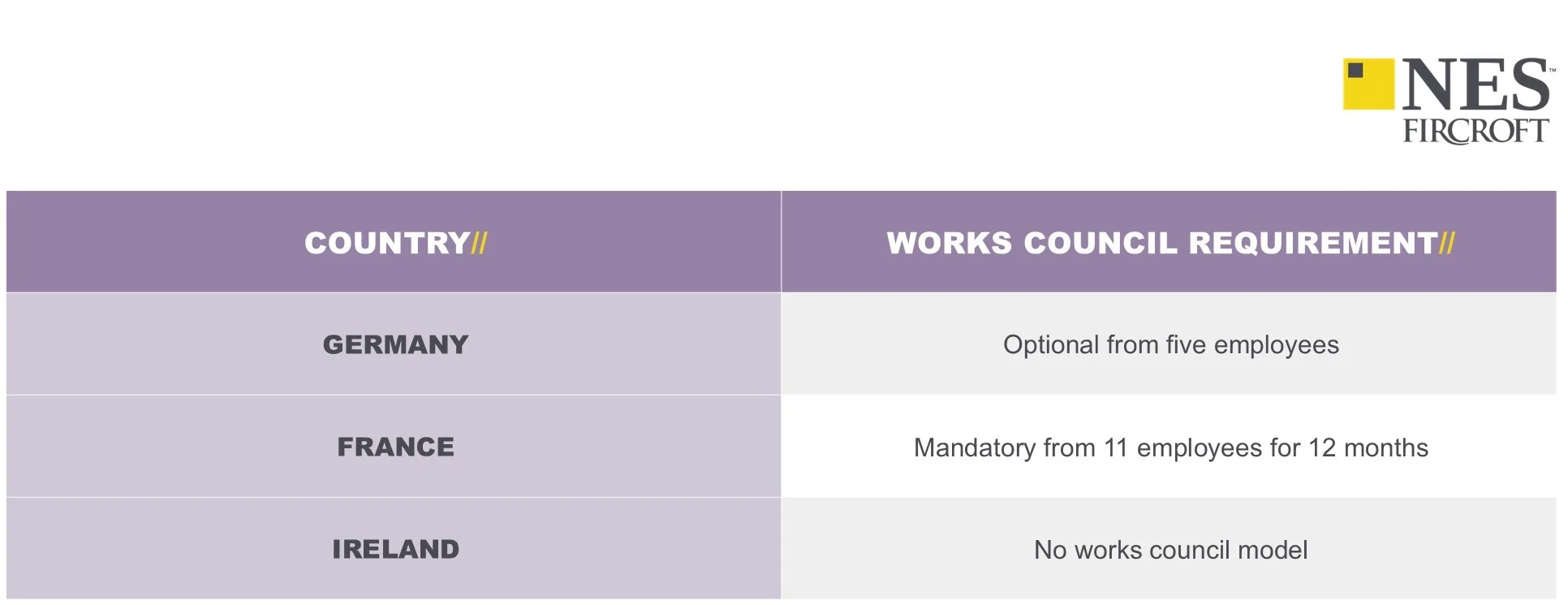
For example, in Germany, if there are five employees or more at a company, they have the option to establish a works council, or Betriebsrat. This council provides extensive and binding worker protections relating to many aspects, such as remuneration, working time, code of conduct and dismissals.
France operates a similar body, the Comité Social et Économique (CSE), which carries its own consultation rights and legal protections for employees, although they are much more limited than in Germany. The other difference is that a CSE is mandatory when a company has at least 11 employees for 12 consecutive months
Belgium extends collective bargaining agreements automatically across entire industry sectors, so a project’s pay and conditions can be set by a national agreement that the employer never directly negotiated.
Ireland takes a markedly different approach. Irish employment law rests on common law, statute and constitutional rights rather than the works-council model used across much of continental Europe. Also, trade union recognition is not a legal requirement for employers.
As a consequence, aspects such as notice periods, dismissal protections and the extent of collective consultation all vary widely. In several countries, ending an employment contract requires specific legal grounds and, in some cases, court or labour authority involvement, rather than being a simple management decision. So, a process that is routine in one market can stall a project timeline entirely in another.
For a company operating CapEx projects across European countries, the compliance approach has to change at every border. One of the most common mistakes organisations make is assuming labour compliance requirements are harmonised across Europe when they are not.
There is no single, Europe-wide definition of what ‘compliant employment’ looks like on a live build.
When staff are sent to temporarily work in another EU country, they typically fall under the Posted Workers Directive. The original directive dates from 1996 and a significant revision took effect from July 2020, covering long-term posting, remuneration and working conditions along with other aspects.
The current rules require equal pay for equal work: posted staff must receive the same remuneration as local employees doing the same job, applied from day one of the posting. Postings can run for up to 12 months, extendable by a further six, after which the host country’s labour law applies in full.
Large sectoral or regional collective agreements can also apply to posted staff, not only company-level terms. Employers generally need to notify the host country’s authorities before work begins, and posted staff require an A1 certificate confirming which country’s social security system covers them while they work abroad.
The scale involved is considerable. Across the EU, there are roughly 3.6 million postings a year, involving 2.6 million individual posted workers, with construction, manufacturing, and professional and scientific services among the largest sectors affected.
In practice, employers need to work through several steps to ensure compliance before a single employee crosses a border:
Each EU country has also interpreted parts of the directive differently, with its own exemptions for short-term activity, adding another layer of complexity for employers.
The good news, though, is that the EU is also working to simplify some of this. A digital, standard e-declaration system for posting notifications is being developed to replace the current mixture of national forms, with the Council and Parliament reaching agreement on the proposal in June 2026. Estimates suggest the electronic standard form could save employers more than 70% of the time and 81% of the administrative cost currently spent on posting declarations, once all member states adopt it.

Before deploying staff across borders, employers should be aware of the most common workforce compliance risks:
Failure to address any of these issues can result in financial penalties, project delays and increased regulatory scrutiny, particularly in highly regulated sectors such as life sciences
Non-compliance with European labour laws carries real financial and reputational costs. Missed notifications, incorrect pay calculations or the failure to secure an A1 certificate can trigger fines, back-payments and delays to a CapEx build already running against a fixed schedule.
Enforcement is also becoming more co-ordinated across borders. Between 2019 and 2023, the European Labour Authority supported 168 cross-border labour inspections, checking the status of more than 13,500 workers in high-risk sectors.
For a GMP-regulated facility, the stakes extend further still. A compliance dispute that stalls a workforce can just as easily disrupt validation timelines, regulatory inspections and the date that a facility is legally permitted to start operating.
Reputational exposure follows a similar pattern. Regulators, host-country authorities and future project partners all take note when a company has a history of workforce compliance failures on previous builds. For life sciences organisations operating under strict quality and audit regimes, that history can affect how closely future projects are scrutinised.
An Employer of Record, or EOR, is a third-party organisation that formally employs staff on a client’s behalf in a given country, handling payroll, tax, social security and local employment law compliance. For CapEx projects spanning multiple countries, an Employer of Record in Europe allows companies to deploy specialist teams quickly without the significant overhead of first setting up a legal entity in every market.
This matters most where speed determines a project’s viability. Establishing a local entity in Germany, France or Belgium can take months to complete. But EOR services can typically have contracts, payroll and posting notifications in place within days or weeks rather than months.
EOR services also remove the country-by-country uncertainty from life science recruitment across Europe. A specialist provider continuously tracks each jurisdiction’s rules on collective agreements, working time, posting notifications and so on, meaning that the project team can stay focused on delivery rather than local employment law detail.
CapEx projects also rarely need the same headcount from one phase to the next. Design, construction, commissioning and qualification each demand different skill sets and different team sizes. An EOR structure lets a project scale up specialist teams during peak build phases and then scale down again as the project matures, without the fixed cost or legal complexity of setting up new entities for each stage.

At NES Fircroft, unlike many generalist recruiters, we offer dedicated life science recruitment services. We have spent 20+ years placing specialist engineering and technical experts into GMP- and GxP-compliant CapEx projects across Europe, from greenfield builds to expansions and retrofits. Our consultants understand what compliance means for a live construction and commissioning programme, not just for a single hire.
Our 15 regional offices include on-the-ground consultants across key markets like the UK, Ireland, Germany, Switzerland, France, Belgium and the Netherlands. This means we can proactively provide clients with direct knowledge of local labour laws, regulations and talent markets in each country, rather than a single generic view applied everywhere.
We support the entire CapEx lifecycle: sourcing, onboarding, payroll, compliance, EOR services, visa and work permit support, and executive search. Whichever markets your project spans, we build flexible staffing solutions around your budget and timeline.
Workforce compliance is not simply a box to tick once a project starts. It needs to be built into planning right from the outset, alongside the engineering, procurement and construction decisions that shape a CapEx build.
If your next multi-country build needs specialist life science recruitment in Europe, backed by real compliance expertise, get in touch with us today.