Navigating German Employment Laws: A Complete Guide
23 Sept, 2026


Key Takeaways: Poland’s economy is growing strongly, but there are talent shortag...

Poland’s staffing market presents a complex picture for employers across engineering, IT, construction and life sciences. On one side, demand for skilled professionals continues to rise, reflecting the country joining an elite group of just 20 out of 195 global states when its economy passed the trillion-dollar mark in 2025.
But on the other side, long-standing labour supply issues threaten to hinder economic growth across many sectors, with employers struggling to find suitable talent at a time of low unemployment.
Understanding where and why these pressures are concentrated is the first step towards building a recruitment strategy that actually delivers results.
This blog examines the staffing challenges in Poland today and explains how a specialist recruitment agency – with the right sector knowledge, networks and local presence – can make a measurable difference.
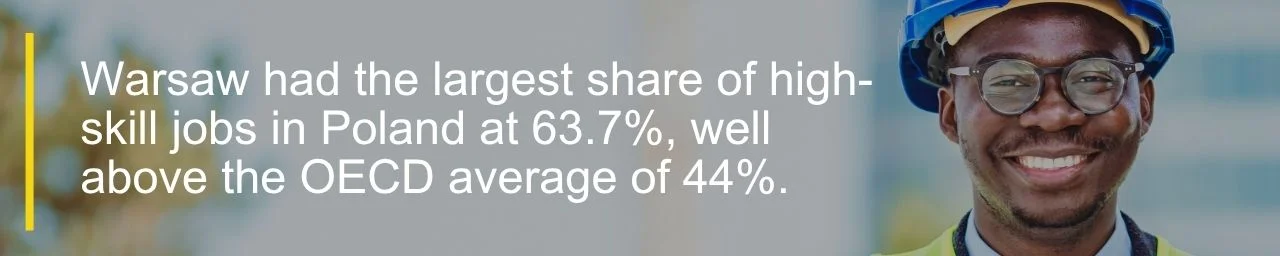
Recruitment challenges in Poland vary significantly by region. Cities such as Warsaw, Wrocław, Gdańsk and Kraków benefit from established talent pools, strong academic institutions and international investment. As a result, for example, in 2022 Warsaw had the largest share of high-skill jobs in Poland at 63.7%, well above the OECD average of 44%.
Beyond these established centres, however, the picture changes dramatically as other regions face limited access to skilled labour: employment rates in 2023 ranged from 65.6% in Podkarpacie up to 80.6% in Warsaw.
This imbalance creates several issues:
The implication for companies operating across multiple Polish locations is clear: a single recruitment strategy is unlikely to be successful. Effective strategic staffing solutions in Poland require detailed local knowledge of where specific skills are concentrated – and where they are absent.
Engineering recruitment agencies consistently report skills shortages in Poland in core disciplines, such as civil, electrical, mechanical and chemical engineering. More specifically, in 2024 the occupations with the biggest shortages were building and related trades (excluding electricians), alongside metal, machinery and related trades.
These shortages are not only driven by commercial construction and manufacturing expansion. Poland’s energy transition – including investment in renewables, grid infrastructure and a gradual phasing out of coal – is creating demand for power and electrical engineers, often requiring specialised skills that domestic education pipelines are not yet producing at scale.
For companies in the engineering and construction sectors in Poland, this is a recruitment challenge that cannot be solved with standard job-board approaches.
Suggested Read: Top Recruitment Challenges in Germany
Poland has become one of Europe’s leading destinations for technology companies, which is reflected in the high demand for IT talent.
Poland is estimated to lack around 147,000 IT specialists (relative to EU benchmarks) and around 42% of vacancies are considered difficult to fill, so many companies have reduced hiring plans as a result.
Unfortunately, the number of current graduates is insufficient to close that gap. Plus, IT recruitment in Poland has become increasingly competency-specific, with employers looking for candidates combining software engineering knowledge with data capability and automation experience.
So, the key challenge is not only quantity, but also alignment of skills with business needs.
Poland’s life sciences sector – encompassing pharmaceuticals, biotechnology and medical devices – already employs 150,000–200,000 workers. Sizeable workforces exist in Warsaw, Kraków, Wrocław and Poznań, all of which have significant university and research infrastructure.
But investment in R&D and startups in Poland is further boosting demand for highly specialised professionals. Even in the well-supplied locations, life sciences recruitment is becoming ever more competitive. Specialists in regulatory affairs, biotechnology, quality assurance and clinical research are in especially high demand.
So, companies entering or scaling in Poland’s life sciences market should expect a hiring timeline that reflects this. It is also advisable to partner with a specialist life sciences recruitment agency in Poland early in any expansion programme.

The demographics of Poland’s labour market are among the most challenging in the European Union. Poland’s workforce is ageing, with fewer young entrants and more people remaining in employment beyond traditional retirement age.
The share of the population in Poland aged 65+ increased by 5.6 percentage points over the last decade – one of the largest increases of any EU member state. Also, Poland’s fertility rate stands at just 1.48 children per woman, which is up from 1.16 in 2023 but still way below around 3.5 in the 1950s. Overall, the total population has remained more or less static since 1985 at 37–38 million and could even fall to 29.4 million by 2060.
The consequences for the labour market are stark: by 2035, Poland’s workforce could shrink by 2.1 million people – a 12.6% decline. The industrial sector alone could lose 805,000 workers.
In practical terms, this means that many businesses are already losing experienced engineers and technical specialists to retirement faster than they can replace them. This raises important questions about long-term workforce sustainability.
Suggested Read: Top Recruitment Challenges in France
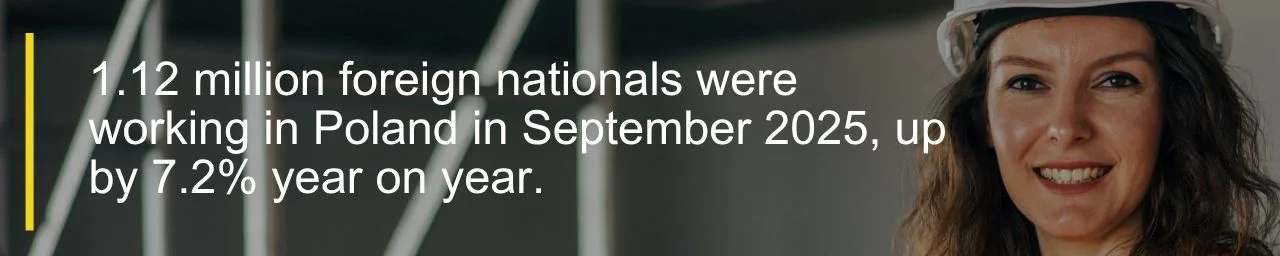
With the domestic supply insufficient across many technical sectors, Polish employers are increasingly turning to foreign workers to fill the gap. Approximately 1.12 million foreign nationals were working in Poland in September 2025, up by 7.2% year on year.
This dependency on international talent is not inherently problematic, but it does bring compliance and integration challenges. Polish immigration law requires careful management of work permits, residence documentation and regulatory obligations, plus the rules governing non-EU nationals are considerably more complex than those applying to EU citizens. The consequences of errors – for both employers and employees – can be severe.
But the effective integration of internationally recruited workers requires more than just paperwork: language support, cultural orientation and effective onboarding all affect retention. Companies that under-invest here often find that they have solved a short-term headcount problem only to face high turnover within the first year.
These recruitment challenges require a tailored and structured response. This is where a specialist recruitment agency in Poland, such as NES Fircroft, can add real value.
We support organisations through a combination of local expertise and international reach. With multilingual teams based in Warsaw and Wrocław, we offer insight into both regional and global talent flows.
We focus on building pipelines rather than just reacting to vacancies. This includes:
This approach helps to reduce time-to-hire and improve candidate quality.
As a recruitment agency in Poland, we operate across industries such as:
This gives our clients access to pre-qualified candidates who understand specific industry requirements, rather than generalist applicants.
In a competitive hiring market, positioning matters. We support clients with employer-branding strategies that attract and retain talent.
At the same time, our dedicated compliance teams assist with:
This reduces the risk and administrative burden for employers.
Recruitment challenges in Poland are not uniform and cannot be addressed with a single approach. So, organisations that use strategic staffing solutions are better placed to secure the talent they need.
At NES Fircroft, we combine local knowledge with global networks to support this process. Contact our Poland team today to discuss your local hiring requirements.

Building a compelling employer proposition – including competitive compensation, clear career progression and strong employer branding – is essential. But it needs to be paired with targeted sourcing through networks that reach passive as well as active candidates.
Shortages in engineering cover civil, electrical, mechanical and chemical disciplines, as well as skilled trades including welders, electricians and HVAC technicians. In IT, cybersecurity professionals, data analysts and cloud engineers are difficult to source.
Here at NES Fircroft, we are an international recruitment agency operating across engineering, IT, construction and life sciences (among others) – sectors where Poland faces major hiring challenges. With multilingual teams based in Warsaw and Wrocław, we combine local market knowledge with an international candidate network.
For specialist and niche IT roles, our IT recruitment services in Poland are specifically designed to go beyond generalist databases. Our consultants work within defined technical disciplines and maintain active relationships with experienced professionals. This gives our clients access to candidates that standard recruitment approaches are unlikely to find.