How to Deal with Job Rejection
23 Nov, 202610:50You prepared for the interview, explained your technical experience and pictured yourself co...


You prepared for the interview, explained your technical experience and pictured yourself contributing to the project. Then you heard you hadn’t been selected. It’s understandable to feel disappointed, especially when the role matched your skills. So, what should you do after a job rejection? Give yourself time to process it; respond professionally if a reply is appropriate; ask for feedback where possible; and review what you can improve before your next application. A rejection only tells you that you weren’t selected for one role at one point in time; it doesn’t define your ability.
Prefer a quick overview? Watch our five tips for handling job rejection.
What can a job rejection tell you? And what it cannot
For engineers or in project-based hiring, the final decision may depend on requirements you can’t see in the job description or interview. A decision can turn on timing, location, a particular clearance or a change to the actual project itself. That doesn’t remove the disappointment, but it can help you respond to the information you actually have, rather than the harshest explanation you can imagine.
You might have strong technical skills but be unable to meet an immediate start date. You might be well suited to the work but not available for the required site pattern or location. Another candidate might already hold a specific certification or clearance required by the project before work can begin. There are numerous reasons for job rejections that don’t come down to your actual capabilities, or whether your judgement, experience or career direction is wrong.
The point is, from all these possibilities, you can’t reliably infer the reason from a standard email. Try to separate what you know from what you’re assuming before deciding on what to do next. If you were told the role required a certain qualification that you don’t currently hold, then that’s useful information, but if you received no detail, you also don’t need to fill in the blanks with a story about your worth.
Give yourself room to be disappointed
It’s very common to feel disheartened when you receive a rejection, but you don’t have to turn it into an improvement plan or development exercise immediately. If you were excited about the position, give yourself time to acknowledge that you wanted it. You can feel disappointed and still recognise that the outcome may have depended on factors outside of your control.
If it helps, step away from the email to decide whether to reply. A response written while you’re upset might not reflect how you want to present yourself. You can return when you feel ready to ask a clear question or thank the person who updated you. If the process involved substantial preparation or travel, you may need more time to reset before your next application.
Also try not to compare the decision with an imagined version of the person who got the role. Competition for jobs is a factor in its own right. In the UK, the Office for National Statistics estimates there were 2.4 unemployed people for every vacancy between July and September 2026, and SmartRecruiters’ 2025 benchmark data found that employers receive an average of 72 applications per role. Across its global dataset, the average role led to about 3 interviews and 1 offer, so being unsuccessful is a normal part of the search, even for strong candidates. In the end, one person was the right fit, but you don’t know their circumstances or the final shape of the job requirements. Your energy is better spent understanding what, if anything, you can learn about your own search and future applications.
How do you respond professionally to a job rejection email?
If you have been in contact with a recruiter or interviewed for the role, a brief reply can thank them for their time and keep the relationship open. You don’t need to challenge the decision or write a lengthy explanation. A response is generally less necessary if you received an automated rejection early in the application process.
You could write:
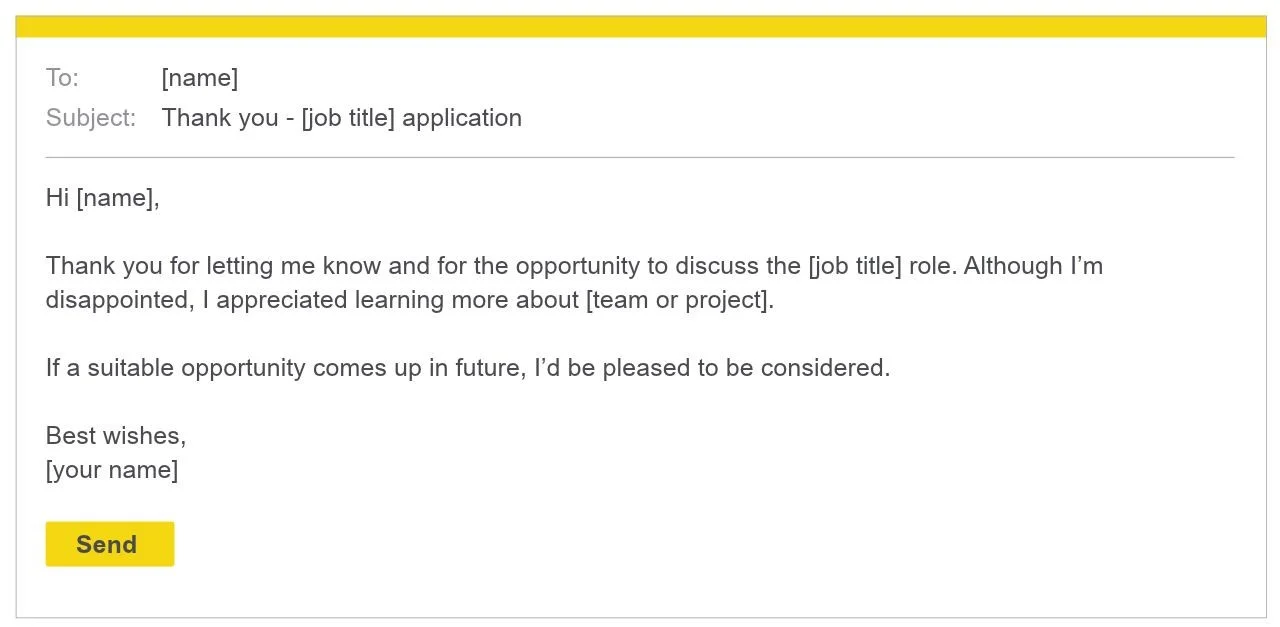
Adapt the message to the contact you actually had. If you didn’t speak with the team, for example, you don’t need to say that you enjoyed meeting them.
How do you ask for feedback after job rejection?
Feedback is most useful when it helps you make a decision or change something specific. If you reached an interview, you could ask whether there was a requirement you could have demonstrated more clearly, or whether availability, location or project experience influenced the decision, but keep it specific and easy to answer.
You can add a request to your reply above, or send a short message such as:
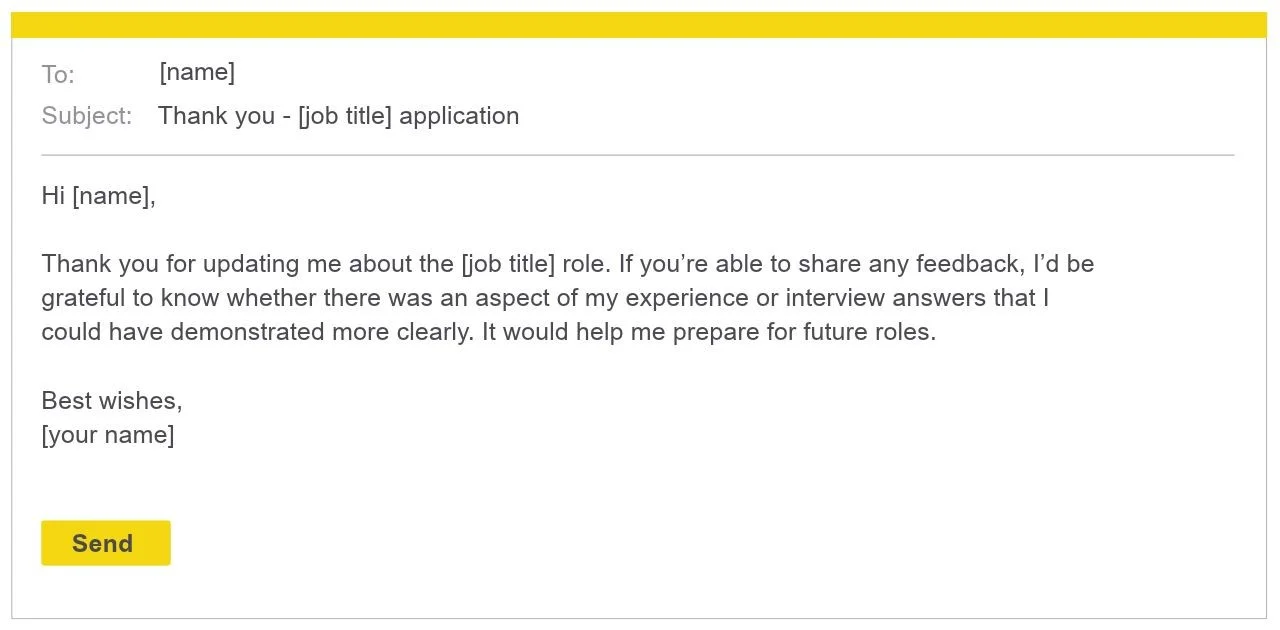
The recruiter or employer may not be able to provide detailed feedback. Sometimes the person replying has limited information; sometimes a hiring decision doesn’t translate neatly into advice. You can still make use of whatever is available without treating silence as proof that you performed badly.
If you do receive feedback, separate actionable points from role-specific constraints. You can, for example, improve how you explain your commissioning experience, but you may not be able, or willing, to change where you live for a site-based assignment. You can practice one skill while using the other to target roles that better fit your circumstances.
Can you reapply for a job after being rejected?
Sometimes, but check the employer’s guidance and consider what has changed. Reapplying immediately for the same vacancy with an unchanged application is unlikely to provide any additional useful information. A later application may make more sense if the role is different, your experience has developed, or you can now meet a requirement you couldn’t meet before. It can also help to understand the best times of year to apply for jobs, as hiring tends to rise and fall with budgets and project cycles.
If you have a recruiter contact, you can ask whether they would welcome an application for a future role and which opportunities would best suit your experience. You can also express continued interest without asking them to reconsider a decision that has already been made.
How can you improve your next engineering application?
Once you’re ready, review both your application and the role you applied for. You don’t need to rewrite your career around one rejection. Look for a few useful adjustments:
- Make relevant experience easy to find. Does your engineering CV clearly show the equipment, systems, project phases or disciplines most relevant to the work?
- Explain your contribution. In interviews, can you give specific examples of how you solved a technical problem, worked with other disciplines or responded when requirements changed?
- Check practical requirements. Are your certifications, availability, location preferences and site-working arrangements accurate and visible where relevant.
- Assess the fit in both directions. Did the working pattern, project scope and location genuinely suit you?
Keep a brief record of applications, interviews and any feedback. If several conversations point to the same gap, it may be worth addressing. If the reasons differ, the changing needs of individual projects may be more significant than any one aspect of your profile.
What should you do next?
It can be tempting to respond by applying for every role that looks remotely relevant. That may leave you spending time on positions with the same barriers as the one you missed. Instead, consider what the process revealed about the work you want and the conditions you can meet.
You might refine how you present an existing skill, explore a related project phase, or consider a qualification that repeatedly appears in roles you want. It’s also worth putting time into networking for engineers; former colleagues, industry contacts and specialist recruiters may hear about opportunities that better match your experience.
Improve Your Job Search with NES
Speaking to a specialist recruiter is one of the quickest ways to turn that thinking into a plan. They can help you understand which parts of a brief are essential and which depend on the project, so you can see where your experience fits. You can ask about expected start dates, site requirements, whether your certifications match the work, and you can be direct about your own constraints. Knowing what you can accept makes it easier to focus your search.
At NES, our recruiters work across a wide range of engineering and technical roles, and our network of 80+ physical offices worldwide means we can connect you with a variety of projects across many markets. That reach doesn’t mean every role will suit you, but a conversation can show where your skills and preferences line up with the work on offer.
You can browse our latest roles today or, to be considered for new jobs as they arise, register on our candidate portal and upload your CV, so one of our specialist consultants can connect you with suitable opportunities.