How Can Employers Tackle Canada's Mining Talent Shortage?
21 Oct, 202613:28Employers can tackle Canada’s mining talent shortage by widening their recruitment pools and...
Employers can tackle Canada’s mining talent shortage by widening their recruitment pools and investing in training that keeps pace with the changing nature of mining work. The industry needs tens of thousands of additional workers over the next decade due to retirements and new project approvals tied to critical minerals. Companies willing to broaden who they hire and how they train and retain them are better positioned to secure the people they need before competitors do.
Key Takeaways:
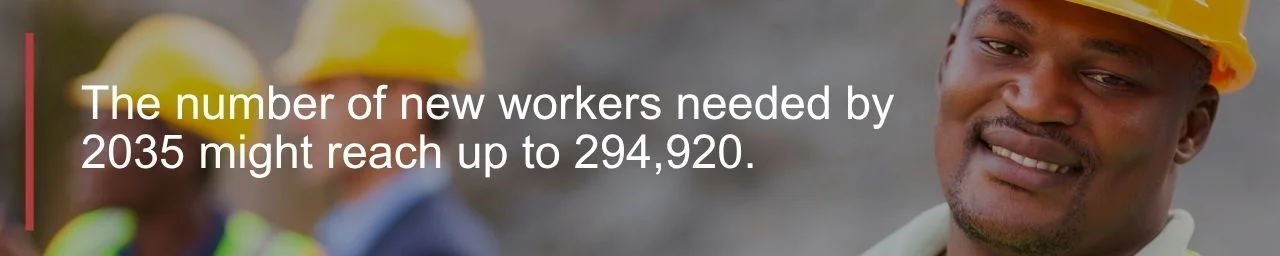
- Canada’s mining sector needs an estimated 242,400 and 294,920 new workers by 2035, according to MiHR’s long-term outlook.
- Around 20% of the current mining workforce is aged over 55, while younger people remain underrepresented.
- Employers making progress are widening where they look for talent, including women, immigrants, Indigenous workers and tradespeople moving over from construction.
- Digital and automation skills now sit alongside traditional trades knowledge in many mining roles.
- Working with a specialist mining recruitment agency can open up candidate networks that internal teams don’t have time to reach on their own.
Is there a shortage of miners in Canada?
Yes. Canada’s mining workforce is already under pressure, and the gap is expected to widen over the next 10 years. MiHR calculates the number of new workers needed by 2035 somewhere between 242,400 and 294,920, once retirements and hiring for expanding projects are added together. Other estimates land in a similar range. The International Energy Agency has pointed to a need for 100,000-220,000 replacement workers by 2033 alone. The shortage isn’t limited to people working underground or in extraction, but also engineers, geologists, tradespeople, operators, maintenance specialists and environmental staff.
Part of the pressure comes from how much mining activity is planned. There are more than 130 mining projects moving through development across the country, representing close to $117 billion in potential investment. Federal spending announced in the 2025 budget, including a $2 billion Critical Minerals Sovereign Fund, has strengthened that pipeline further. Mining employment currently sits above 100,000 for the first time on record, and unemployment within the sector runs well below the national average. That tightness is a sign employers are running out of easy hires and need to look further afield for mining candidates.
What’s causing Canada’s skills gap?
A few factors contribute to the shortage. But one of the clearest is age. Roughly one in five mining workers in Canada is 55 or older, while only about one in twenty is under 25. This imbalance means the industry is losing experienced staff to retirement faster than it can bring in replacements. MiHR estimates an average labor force exit rate of around 2.7% a year through 2035, most of it retirement-related.
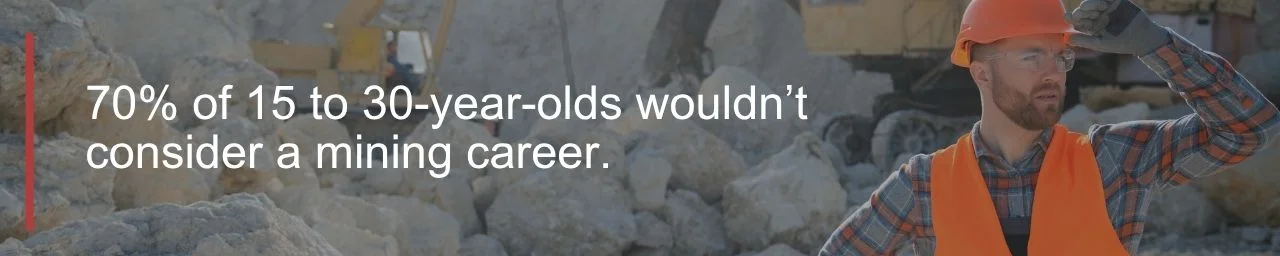
Fewer young people are entering the pipeline to begin with. Mining-related enrolments in Canadian post-secondary programs have declined over the years. This is largely due to outdated ideas about what mining jobs involve, with 70% of 15 to 30-year-olds not considering a mining career at all. This creates a long-term supply problem.
Digitization is also adding to the skills gap, with many companies automating haul trucks, processing plants, and monitoring systems, which changes the skills needed on site even where headcount targets stay the same. Workers with only traditional trades training can find themselves underqualified for the automated version of their roles, while companies compete with construction, energy, and manufacturing for the same pool of skilled tradespeople and engineers.
What are the key challenges in attracting workers to Canadian mining sites?
Mining jobs offer strong compensation and valuable technical experience, but the work comes with conditions that don’t suit every candidate. Many operations are located far from the nearest town, and getting workers there usually means fly-in, fly-out rosters or long-term relocation. This can be attractive for some candidates but not for others, particularly those with young families or partners who also work. Employers need to describe the full working arrangement at the beginning of the recruitment process.
Small communities near mine sites, generally in northern or remote locations, can experience housing shortages that limit the workforce they can support. A candidate might be interested in a position but unable to find suitable accommodation for a partner or children. In this case, employers can improve their offer by explaining what housing is provided, which relocation costs are covered and how family moves are handled for complete transparency.
A lot of jobseekers, especially younger ones, still picture mining as heavy manual labor in an outdated environment. Many don’t associate the industry with the automation, data, and sustainability work that’s a growing part of the job on modern sites. These candidates also tend to ask more direct questions about flexibility, time off between rotations, and career progression than previous generations didn’t, and employers who can’t answer those questions clearly will lose candidates to companies that can.
What technical skills are most in demand in Canada’s mining industry?
Employer surveys keep pointing to the same hard-to-fill roles. Heavy-duty equipment mechanics, electricians and engineers are among the positions companies report struggling with most. Demand also stretches across geology, metallurgy, and project delivery, where experienced professionals are becoming harder to find and, once found, harder to hold onto.
The roles below are what we’ve found come up the most often as hard-to-fill positions:
- Mining engineering positions across exploration, extraction, and processing
- Geologists and geoscientists working with modeling and sensing tools
- Metallurgists and process specialists who can read and act on data from automated plants
- Project professionals, covering planning, construction, and commissioning
- Skilled trades including electricians, welders, millwrights, and pipefitters
- Maintenance specialists and heavy equipment operators for haul trucks, excavators, and dozers
Layered on top of this traditional skillset is a newer set of capabilities. Companies now need engineers and technicians who are comfortable operating automated and remotely controlled equipment, along with environmental, ESG, and community specialists who work directly inside operations instead of sitting outside as a separate function. None of this replaces hands-on trades experience; instead, it complements it, which explains why training alone is often insufficient to close the skills gap.
How to Attract Skilled Mining Talent
Employers making the most progress are usually doing more than posting a job and waiting. Workforce planning is moving earlier in the project timeline, with hiring and mobilization lined up against permitting stages, construction milestones and commissioning schedules. You need to plan ahead and start searching early to ensure you don’t miss out on talent, especially as specialized skills are being pursued by multiple projects at once.
Diversity is proving to be one of the more practical levers available. Women hold only around 19% of mining jobs in Canada, and immigrants make up about 13% of the workforce, both figures the industry wants to grow. Indigenous employment is a genuine strength, with more than 12,000 Indigenous workers already in mining and quarrying, and there’s room to build on that through stronger community partnerships. Programs such as the Sectoral Workforce Solutions Program and Indigenous Skills and Employment Training Program are helping build the kind of mineral literacy that gets new candidates ready for the sector faster.
Partnerships with colleges, technical institutes and universities help close the pipeline problem at the source, keeping academic programs matched to what mining employers now need on site. The federal government’s Mining and Minerals Workforce Alliance was recently launched to address labor shortages in the industry, bringing together employers, unions, education providers and industry organizations together around skills development.
For companies without the time or internal resources to run all of this themselves, working with a Canadian recruitment agency that specializes in mining extends the search beyond the usual channels. One of the advantages of working with established mining recruitment companies operating in Canada is access to relationships built over decades, not weeks, plus market knowledge of realistic salary and any expectations for a given role and region.
Best Practices for Retaining Talent in Remote Mining Operations
Winning the hire is only half the job. Turnover on remote sites is expensive, and a lot of it is preventable. High wages still draw people to remote postings, but long-term retention comes down to culture, development, and the balance between work and time off, not just pay.
Clear progression paths matter more than you might assume. Workers who can see a route that begins in an entry-level role and can lead to trade certification, a supervisory position or a specialist track are far more likely to stay through a downturn or a tough rotation. Wellbeing support, honest communication about shift schedules and a safe, respectful site culture all play into whether someone renews their contract or starts looking elsewhere.
Flexible workforce models are also key to talent sourcing and retention. Permanent, contract, and hybrid arrangements let you bring in project controls, commissioning and site leadership professionals for exactly when you need them, and offering various working options gives some candidates the flexibility they need to take the role at all. Employer of Record (EOR) arrangements can support this by handling the compliance aspects of cross-border and interprovincial mobility, which matters more as companies pull talent from farther away to fill locally limited gaps.
Final Word: How can employers tackle Canada’s mining talent shortage?
There isn’t a single solution for Canada’s mining talent shortage, because it isn’t caused by one problem. An aging workforce, a shrinking pipeline of young candidates, remote and demanding site conditions and a fast-changing skills list are all playing a part, and each needs its own response.
The employers making headway are treating recruitment, training, and retention as one connected effort instead of three separate jobs. Practically, that includes planning hiring around project timelines instead of reacting to them, and widening search to include women, expats, Indigenous workers, and tradespeople moving over from construction. It also means investing in training and upskilling that keeps pace with automation and building the kind of site culture that reduces attrition. Employers who commit to this combination are best placed to staff the wave of critical minerals projects moving through Canada’s development pipeline over the next decade.
How NES Fircroft Helps Mining Companies Secure Specialist Talent
NES Fircroft has worked in Canadian mining recruitment for more than 18 years, with offices across the main mining provinces, backed by a global network. Our reach enables you to recruit both expatriates and candidates already based in Canada. Our EOR services and assignment teams handle work permits, LMIA applications, payroll, and tax compliance for all hires, covering the entire mining project lifecycle.
Our mining recruiters specialize in everything from senior technical leadership roles to trades personnel, drawing on relationships built over decades to quickly connect you to the talent you need.
Have an upcoming project or need additional recruitment support for a mining project in Canada? Get in touch with our expert team today.
People also ask:
What are the top mining trends shaping workforce demand in Canada?
Automation, sustainability commitments and the move towards critical minerals are among the biggest forces changing the roles mining employers need to fill. Our related read, Top Mining Trends to Watch in the US, Canada, and LATAM, covers this in more depth.
How is the mining workforce changing across the Americas?
Workforce patterns across the US, Canada, and Latin America are moving in similar directions, with greater demand for contract and rotational talent and a stronger focus on the employer value proposition (EVP). Read more in our blog.
Can mining companies recruit international talent for Canadian projects?
Yes. Programs such as the Federal Skilled Worker Program and Provincial Nominee Programs prioritize mining professionals, and EOR services can manage the work permits and compliance involved in bringing international talent onto Canadian projects. See how mining workers from Australia are choosing to work in Canada here.