The Top Skills Needed for Offshore Wind Projects in Asia
29 Oct, 202611:09Offshore wind projects depend on expertise across engineering, construction, marine operatio...

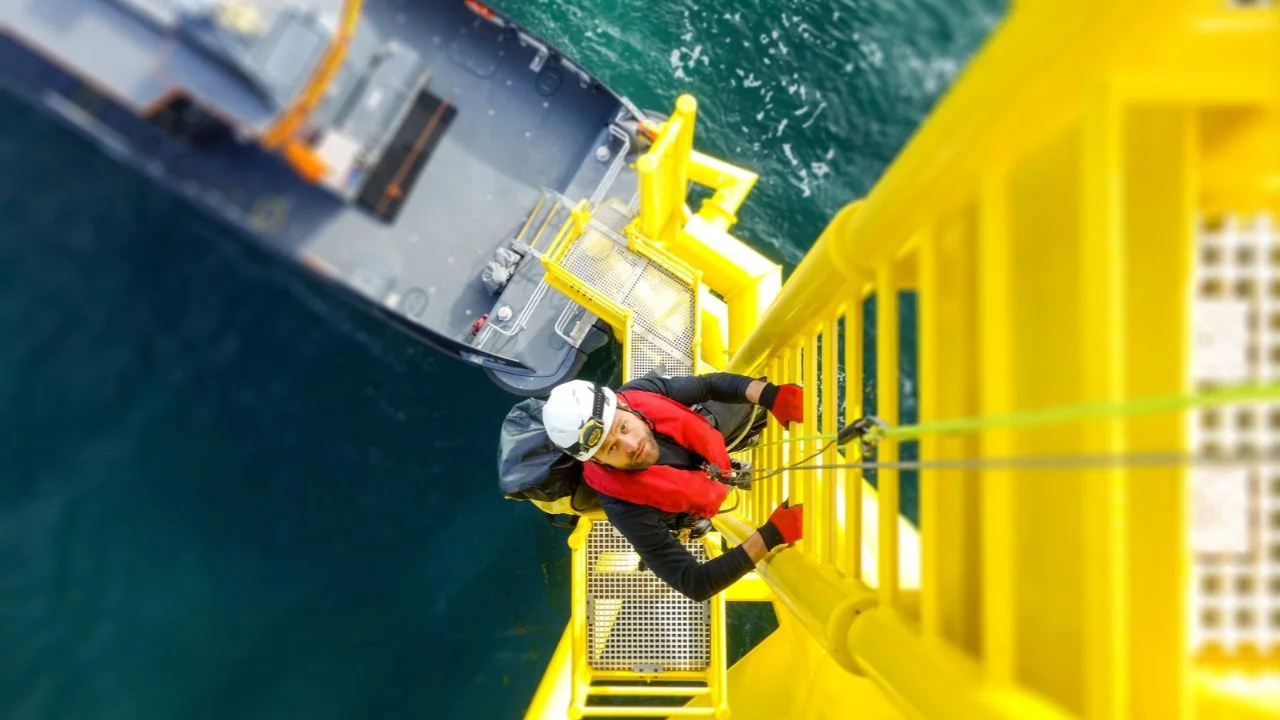
Offshore wind projects depend on expertise across engineering, construction, marine operations, grid connection and project management. As deployment accelerates across Asia, demand for experienced personnel is increasing, particularly in areas where projects rely on specialist technical and offshore delivery skills.
Asia holds most of the world’s offshore wind capacity (58%), but there is a shortage of qualified and experienced professionals. Package managers control the interfaces between contractors, where a waiting installation vessel can cost hundreds of thousands of dollars a day. Offshore construction and marine specialists plan and run the installation at sea, but the pool of professionals who are able to move from oil & gas and marine construction remains limited. HV electrical, cable and grid connection specialists are essential, as grid capacity is arguably the region’s biggest constraint. Flexible workforce models help to secure and retain scarce talent.
Key Takeaways:
- Asia held 58% (53.5 GW) of global offshore wind capacity at the end of 2025, with most of it (48.4 GW) in China. Elsewhere in the region, growth is happening, but auctions and investment decisions can be delayed.
- Offshore wind skills shortages are found in: 1) package managers for WTG, foundations, cables and OSS; 2) offshore construction and marine specialists; and 3) HV electrical, cables and grid connection.
- Grid capacity is one of the largest constraints, so HV electrical, cable and grid connection specialists are critical hires.
- Combining permanent hires with contract specialists and recruiting from oil & gas helps companies to respond quickly when investment decisions land.
Asia’s Growing Offshore Wind Projects
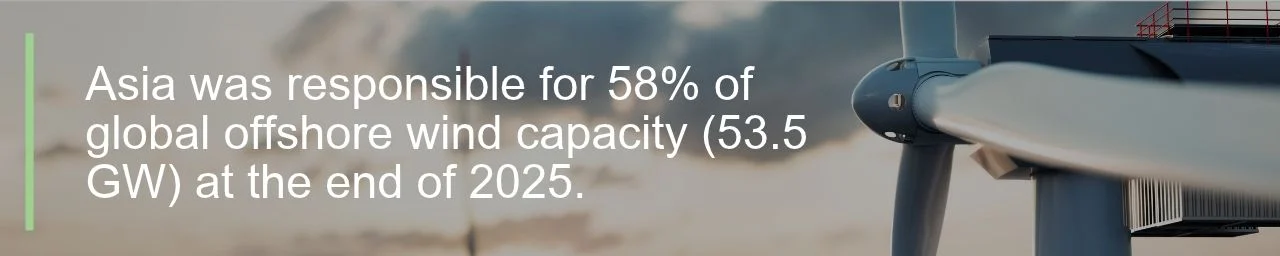
Asia already holds most of the world’s offshore wind capacity. According to the Global Offshore Wind Report 2026, Asia was responsible for 58% of global capacity (53.5 GW) at the end of 2025, with the vast majority of that total (48.4 GW) in China.
Taiwan shows one of the clearest signs of growth in the region. In 2025, it commissioned 600 MW across the Hai Long 2 & 3 and Greater Changhua 2b & 4 offshore wind farms. The 1 GW Hai Long project is planned to reach full commercial operation in 2027.
Growth is also found in South Korea, where two offshore wind projects – Jeonnam 1 (96 MW) and Yeonggwang Yaksu (4.3 MW) – were commissioned in 2025. In addition, South Korea’s Offshore Wind Promotion Act came into force on 26 March 2026, with the aim to increase the country’s offshore capacity tenfold by creating a more streamlined approach to the licensing and permitting process.
Elsewhere, Victoria opened Australia’s first offshore wind auction, for 2 GW, in August 2026. This is sufficient to power up to 1.5 million homes, and the goal is to integrate offshore wind to complement the state’s solar, onshore wind and storage capabilities.
However, this growth in Asia isn’t without occasional setbacks. In August 2025, Mitsubishi withdrew from three Round 1 projects in Japan totalling around 1.7 GW, amid rising costs, weakening exchange rates and supply chain constraints. Also, the Philippines suspended its first offshore-wind-only auction, the 3.3 GW GEA-5, in July 2026 to review permitting requirements, port and grid readiness, costs, and global supply chain disruption, with bidding tentatively rescheduled for 1 December 2026.
For those planning offshore wind recruitment in Asia, there is a clear lesson: schedules may change, but when investment decisions finally land, there will always be significant demand for experienced personnel.
Offshore Wind Skills in Demand
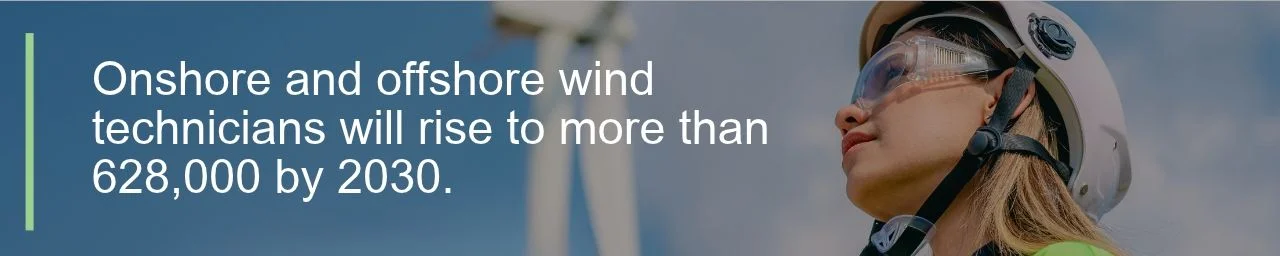
The Global Wind Workforce Outlook 2025–2030 estimates that demand for both onshore and offshore wind technicians will reach 493,000 in 2026 before rising to more than 628,000 by 2030. The GWO also warns that scaling a workforce can take up to a decade.
The encouraging news, though, is transferability. The UK Offshore Energy Workforce Transferability Review in 2021 found that more than 90% of the UK’s oil & gas workforce has medium-to-high skills transferability to other energy sectors, including wind. This supports a practical strategy for offshore wind projects around the world: recruit marine and construction professionals from oil & gas or other adjacent sectors, then close specific offshore wind skills gaps through targeted training and GWO certification.
Within this growth in offshore wind recruitment in Asia, there are three roles in particular that are under the greatest strain:
1. Package Managers for WTG, Foundations, Cables and OSS
An offshore wind farm is typically delivered through separate packages: wind turbine generators (WTG), foundations, array and export cables, and the offshore substation (OSS). Each package brings its own contractors, suppliers, fabrication yards and vessel spreads, and every boundary between them is an interface that can fail. Taiwan’s Hai Long project, for example, was built on what its legal team describe as a “complex multi-contracting structure”.
Package managers own those boundaries: scope, schedule, cost, quality and the handover from one contractor to the next. The financial stakes are substantial. Shipbroker Clarksons put day rates for the newest and largest installation vessels at about US$350,000 in 2024, up from roughly US$200,000 in 2022.
While these figures relate mainly to European projects, the direction of travel is nevertheless clear: when a vessel waits on a late component or an interface issue, costs can reach hundreds of thousands of dollars a day. So, strong package leadership is one of the most effective forms of schedule insurance that a developer can buy.
Ideally, clients should look for ownership of a package from contract award through to commissioning, experience of EPCI and multi-contract structures, and the authority to resolve issues before they become critical. In Asia, it’s also desirable to have familiarity with local-content rules, which are either in place or planned in Taiwan (e.g. mandating 60% local content), Japan and South Korea.
For candidates who have managed similar packages in Europe or in offshore oil & gas, this is one of the most direct routes into senior offshore wind jobs in Asia.

2. Offshore Construction and Marine Specialists
Transport and installation (T&I) is where a project meets the sea – currently, the people who plan and run it are difficult to find. Roles in particular demand include installation managers, T&I managers, offshore construction managers, heavy-lift specialists, marine co-ordinators, jack-up vessel specialists and vessel superintendents. The talent pool of professionals who are capable of moving between offshore wind, offshore oil & gas and marine construction remains relatively limited.
Vessel supply intensifies the competition. For example, eight new jack-up installation vessels entered service in 2025, including units for Cadeler, DEME, Shinfox Far East, Yi Hai Offshore and Dominion Energy. Each one needs a marine team that understands key aspects, such as jacking operations, seabed conditions and typhoon-season weather windows.
3. HV Electrical, Cables and Grid Connection
Every megawatt generated offshore needs to be transmitted via the grid network. Offshore wind projects need specialists in array and export cables, offshore and onshore substations, cable installation and burial, protection systems, SCADA and grid compliance. Technicians are needed across 33 kV and 66 kV array systems and higher-voltage offshore transmission networks, including 132/154kV, 220/230 kV, 275 kV and 345/400 kV systems.
As projects become larger and move further offshore, HVDC transmission and converter-station expertise is also expected to become increasingly relevant in APAC.
Grid capacity is arguably the region’s biggest constraint. GWEC’s 2026 action plan urges governments to treat offshore wind and its support infrastructure as critical energy infrastructure, and to develop long-term grid investment plans. Furthermore, GWEC highlight the structural timeline mismatch between transmission planning and offshore wind development cycles.
This is borne out by the evidence. In Vietnam, grid transmission capacity has been cited as a major bottleneck; in South Korea’s Chungcheong region, planned offshore wind may not gain grid access until at least 2032; and in the Philippines, grid readiness was among the issues behind the GEA-5 pause.
Building a Flexible Workforce
Workforce requirements for offshore wind projects rise and fall over time. A project may need a small group of package managers during procurement, large marine and electrical teams during installation, and a smaller permanent team for operations. But this timing depends on auctions and investment decisions that can unfortunately slip, as Japan and the Philippines have shown.
A flexible workforce model blends permanent hires for long-term leadership with contract specialists for peak periods. It also relies on compliant cross-border mobilisation, because work permits, local employment rules and payroll obligations differ in every market.
Retention of these professionals matters just as much, too: consistent rotation schedules, clear progression from one project phase to the next and redeployment across a portfolio all give scarce offshore wind personnel a reason to stay.
This is where a specialist recruiter, such as NES Fircroft, can offer real value with services in talent acquisition and Employer of Record (EOR).
Offshore wind developers will benefit from asking two questions now:
- Which of your critical roles will you need in, say, 18 months?
- If a key package manager or HV lead resigned tomorrow, for example, how quickly could you replace them?
The answers to these questions should drive your recruitment strategy and the decision to partner with an offshore wind specialist such as NES Fircroft.
Supporting Offshore Wind Recruitment in Asia
At NES Fircroft, we bring more than 50 years of global energy staffing expertise, with strong offshore wind capability and membership of the Global Wind Energy Council. Our 29 in-country teams across APAC provide local-language support, regulatory understanding and real-time responsiveness.
We deliver end-to-end workforce solutions across every phase of the offshore wind project lifecycle, offering scalable, compliant permanent and contract staffing. Our global network bridges local skill gaps, drawing on transferable oil & gas talent and established offshore wind candidate pools across Asia, Europe, North America and the Middle East.
To discuss your hiring strategy for an offshore wind project in Asia, contact our team today. Or if you’re a professional looking for your next challenge, explore our latest offshore wind jobs in Asia.