How Can Asia’s Emerging Offshore Wind Markets Overcome Their Skills Shortages?
07 Aug, 202612:52Asia's emerging offshore wind markets can overcome skills shortages by combining local t...


Asia's emerging offshore wind markets can overcome skills shortages by combining local talent with experienced professionals from established offshore wind regions and related industries such as oil & gas. In countries including Vietnam, the Philippines and South Korea, employers are widening their talent pools, supporting skills transfer and using compliant hiring models to bring in specialist expertise where it’s needed. This approach helps projects access secure critical skills while local offshore wind workforces develop.
Key Takeaways:
- Asia’s offshore wind ambitions are outpacing workforce supply. There are many wind projects at various stages of development across APAC, but there is a shortage of skilled professionals to deliver the planned growth.
- Vietnam, the Philippines and South Korea are each at different stages. Vietnam is scaling quickly, the Philippines just launched its first dedicated offshore wind auction and South Korea is targeting significant capacity growth.
- The skills gap stems from three root causes: rapid project timelines outpacing training systems, a global shortfall of wind technicians and competition with established markets like Europe for scarce specialist talent.
- Oil & gas professionals offer an underused solution. Skills in subsea engineering, HSE and project management transfer well into offshore wind roles, often needing only supplementary certification rather than full retraining.
- Employer of Record (EOR) services solve a real compliance barrier. Vietnam, the Philippines and South Korea each have complex, distinct work permit and visa regimes. An EOR lets developers hire compliantly without having to set up a local entity first.
The offshore wind market in Asia is seeing huge growth, powered by government ambition and international investment.
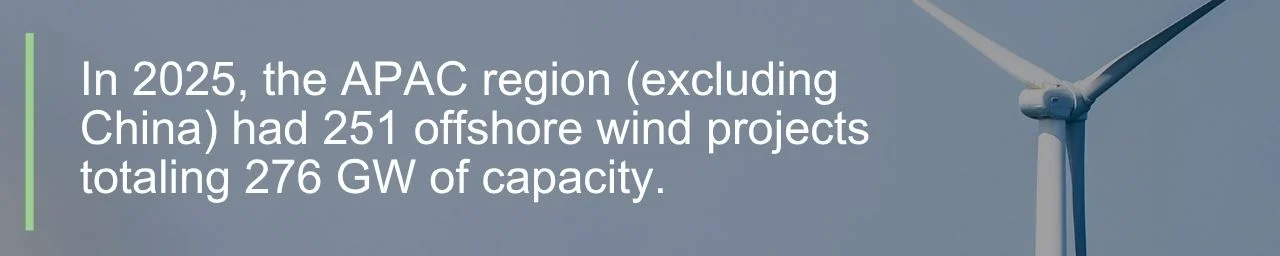
Across the Asia-Pacific region (excluding China) in 2025, there were 251 offshore wind projects, with a combined capacity of 276 GW. In the same year, Vietnam posted the fastest onshore and offshore wind capacity growth rate worldwide. Also, the Philippines opened its first auction dedicated entirely to offshore wind, and South Korea passed a dedicated law to speed up project approval.
But ambition and capability are not the same thing. The problematic question is: who will build, install and operate these offshore wind projects? Ultimately, it’s this offshore wind skills gap that will determine just how fast Asia’s market can grow.
Three Markets, Three Starting Points
Vietnam’s story is one of rapid growth. Under its revised Power Development Plan VIII, the country targets 6–17 GW of offshore wind capacity by 2030–2035, rising to 113–139 GW by 2050. Its onshore and offshore wind sector grew by 50.8% in 2025 alone – the fastest rate of any market globally, way ahead of Chile in second place with 23.9%.
The Philippines is earlier in its journey but moving with purpose. In 2025, the Department of Energy launched the fifth Green Energy Auction (GEA-5). This is the country’s first auction dedicated solely to offshore wind, targeting 3.3 GW of fixed-bottom capacity for delivery between 2028 and 2030. It’s estimated that the Philippines currently has at least 92 offshore wind farm projects with a total capacity of approximately 68 GW, although all remain at the development stage.
South Korea sits between the two. The country plans to achieve 14.3 GW of offshore wind by 2030, although installed capacity remains around 0.2 GW. In response, South Korea enacted its Special Act on the Promotion of Offshore Wind in 2025, alongside a roadmap targeting around 10.5 GW of installed or committed capacity by 2030 and 25 GW by 2035.
“The biggest challenge is that offshore wind is growing faster than the regional talent pool. Many Asian markets are still delivering their first large-scale projects, so there are not yet enough professionals with experience across the full project lifecycle. Competition for experienced specialists is also intense, particularly when several projects enter construction at the same time.” - Dylan Zidi, Regional Business Development Manager – Renewables at NES Fircroft.
Each market has its own targets and timetable, but they all share the same basic mismatch: project ambition is scaling up faster than the workforce needed to deliver it.
Why the Talent Isn’t There Yet
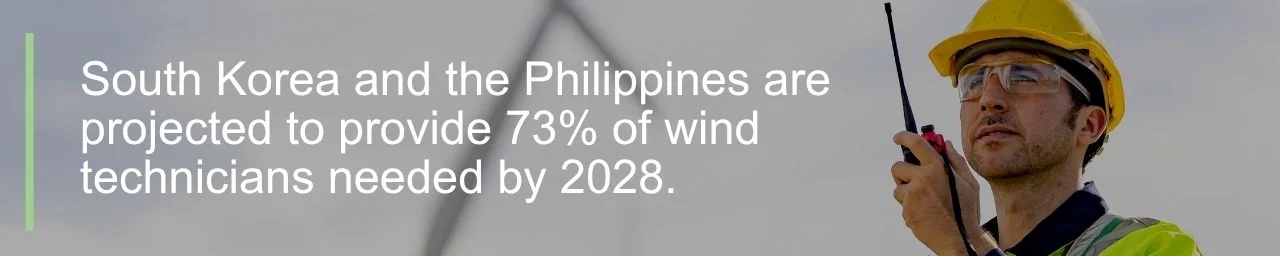
The first cause is simple maths. Globally, it’s forecast that the industry will require 628,000 more onshore and offshore wind technicians by 2030. In addition, in 2024, South Korea and the Philippines were among the ten countries that constituted 73% of the total number of technicians forecast to be working in the sector in 2028. Local talent pipelines clearly cannot keep up with this level of demand.
What roles are most in demand?
“The most sought-after professionals are generally those with proven offshore delivery experience. This includes subsea cable specialists, electrical and commissioning engineers, installation managers, marine coordinators, WTG package managers, vessel specialists and high-voltage authorised personnel.
We are also seeing strong demand for project directors, package managers, fabrication and QA/QC specialists, QHSE professionals, contract managers and operations and maintenance technicians.” - Dylan Zidi
The second cause is timing. Auctions, permitting reforms and turbine orders are often confirmed years before training systems can respond. South Korea’s government has acknowledged this directly: workforce shortages and a lack of experienced personnel pose a risk to investment. A training pipeline takes years to build, but a financed wind farm cannot wait that long.
The third cause is competition from established markets. Europe’s offshore wind sector benefits from decades of head start and deeper local supply chains. Specialist roles such as subsea cable engineers and turbine commissioning specialists remain scarce globally, and experienced candidates often choose a familiar European project over a first-of-its-kind Asian one.
The Oil & Gas Talent Pool: An Underused Option
One route to bridging the offshore wind skills gap in Asia is via an industry often assumed to be a competitor for talent rather than a source of it: oil & gas.
The logic is straightforward. Offshore oil & gas and offshore wind both share similar operating conditions, marine logistics and safety regimes. Using the UK as an example, it’s estimated that by 2030 around half the country’s offshore renewable roles could be filled by workers transferring from oil & gas, alongside new graduates and recruitment from outside the offshore energy sector.
Several disciplines transfer particularly well. Subsea engineers who have designed and maintained underwater systems for oil platforms bring directly applicable skills to offshore wind’s cable and foundation work. HSE professionals are equally portable, since both sectors require strict adherence to permit-to-work systems and emergency response in marine environments.
Project managers possess skills that are perhaps the easiest to transfer. Co-ordinating multi-billion-dollar developments and delivering in tight regulatory environments and weather windows is core oil & gas experience that can be applied directly to offshore wind projects.
Of course, there are differences between oil & gas and wind. For example, wind farm engineering involves very large rotating machinery, and wind power purchase agreements behave differently to oil price cycles. But these differences needn’t be a barrier to entry. Instead, they highlight the need for additional training that experienced professionals are likely to absorb quickly.
However, adjacent industrial capability doesn’t automatically convert into offshore wind capability; it has to be deliberately redirected. This is where NES Fircroft adds value beyond candidate sourcing. We identify which oil & gas professionals hold skills that map onto specific offshore wind roles, manage supplementary certification needs such as Global Wind Organisation training, and place candidates on projects in Vietnam, the Philippines and South Korea.

Employer of Record: The Practical Route to Compliant Hiring
Even once the right candidate is identified, getting them legally working in Vietnam, the Philippines or South Korea is rarely simple. Each country runs its own, often complex, compliance regime, resulting in significant challenges for employers.
Vietnam requires foreign workers to hold both a work permit and work visa under its Labour Code, now governed by Decree 219/2025/ND-CP. There is also a mandatory labour market test, which typically requires the role to be advertised locally for 15 days before any foreign hire proceeds.
The Philippines operates a comparable system. Employers must secure an Alien Employment Permit, supported by a Labour Market Test and an Economic Needs Test, before a work visa can be issued. Combined processing is likely to take several months.
South Korea’s system is similarly demanding. The employer needs to obtain a Certificate of Confirmation of Visa Issuance (CCVI) before the employee applies for a visa (usually E-7), sponsored by the employer, with minimum salary thresholds set by the Ministry of Justice.
This is where an Employer of Record (EOR) in Vietnam, the Philippines or South Korea becomes invaluable. The EOR holds local legal entity status, which allows it to take on payroll, tax and social insurance responsibilities. By doing so, the EOR manages the employer-side compliance burden across each market’s distinct visa regime. This removes a significant barrier to market entry without delaying timelines while corporate registration is completed.
It’s also worth noting that in all three markets, labour and economic needs tests are designed to prioritise local candidates first, so bringing in foreign workers should never be treated as a formality. An EOR partner with deep local experience and relationships protects both the project timeline and the developer’s standing with local regulators.

Where NES Fircroft Fits
At NES Fircroft, we have spent more than 50 years recruiting for the global energy sector, and that history shows in the depth of our offshore wind capability today. We are a member of the Global Wind Energy Council (GWEC), giving us a direct line into the policy and workforce conversations shaping Vietnam, the Philippines and South Korea.
Our strength in offshore wind recruitment in Asia comes from proximity. We operate 29 in-country teams across APAC, with each one providing local-language support, an informed understanding of national regulatory requirements and real-time responsiveness.
We support the full offshore wind project lifecycle, from early-stage development through to construction, installation, and long-term operations and maintenance. Our staffing models flex between scalable contract resourcing and permanent hires, matched to each project phase.
Most importantly, we connect local employers to a global talent network: established offshore wind specialists drawn from candidate pools we have built across Europe, North America and the Middle East, as well as oil & gas professionals whose skills are ready to transfer. Closing Asia’s offshore wind skills gap is rarely a choice between local or international talent. Instead, it takes a combination of both, deliberately and quickly.
If you’re recruiting for an offshore wind project anywhere across the region, contact our team to discover how we can help with your workforce planning.
Frequently asked questions people also ask:
How can offshore wind developers scale their workforce across different project phases in APAC?
Offshore wind workforce requirements can change significantly between development, fabrication, construction, and commissioning. Many use flexible workforce solutions to access specialist talent when needed, control costs and respond quickly to project demands. Learn more about flexible workforce solutions for APAC offshore wind projects.
What are the biggest compliance challenges when hiring offshore wind professionals in Asia?
Recruiting across multiple markets means managing different employment laws, visa requirements, work permits, payroll obligations and local labour regulations. These requirements vary considerably between countries, making compliance planning a critical part of project mobilisation. Read more: Top 5 compliance challenges in offshore wind hiring in APAC