
Top Data Centre Projects in the Middle East
28 Sept, 20269:45The Middle East’s top data centre projects are largely concentrated in Saudi Arabia an...
The Middle East’s top data centre projects are largely concentrated in Saudi Arabia and the UAE, where multi-gigawatt AI campuses are setting new benchmarks for power capacity and infrastructure investment. Flagship schemes led by Humain, Stargate UAE, DataVolt, Khazna, Batelco and MEEZA are expanding regional capacity and strengthening digital infrastructure across the Gulf. These projects reflect the region's ambition to become a leading destination for AI and hyperscale data centre development through to 2030.
Main insights:
- Saudi Arabia and the UAE account for almost 80% of Middle East data centre power consumption, operating 119 facilities and around 780MW of combined capacity.
- The region's largest announced developments include Humain's 6GW Riyadh campus, Stargate UAE's 5GW AI campus and DataVolt's 1.5GW Oxagon project.
- Sustainability is becoming a defining feature of new facilities, with renewable-powered campuses and liquid-cooling technology featuring in new builds.
- Competition for commissioning, operations, electrical and mechanical engineering talent is growing as more facilities enter service and expand operational teams.
The Middle East's data centre market is on track for a 14.92% CAGR through 2030, reaching $19.89 billion, whilst the region's wider digital economy is expected to hit $780 billion in the same timeframe. Focusing on the Gulf specifically, data centre investment is forecast to nearly triple, growing at an 18.85% CAGR from $5.46bn in 2025 to $15.39bn by 2031. This growth is being driven by the rapid adoption of AI and cloud computing, alongside government-backed digital transformation programmes.
Who are the market leaders?
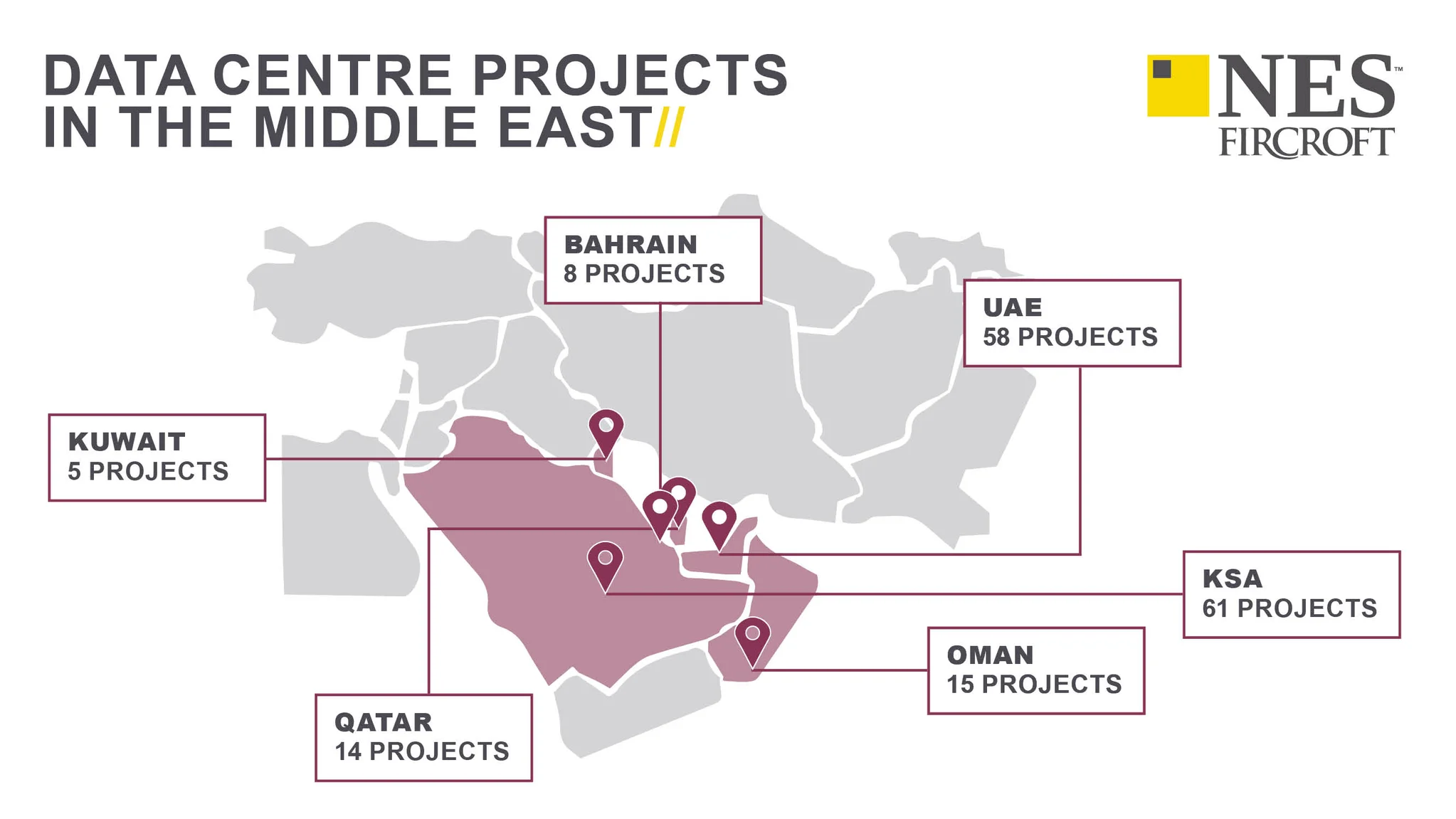
Data Centre Map currently lists 331 projects across 18 Middle Eastern countries, but Saudi Arabia and the UAE are absorbing the bulk of market investment, together accounting for close to 80% of the region's ~1GW of data centre electricity consumption. Saudi Arabia accounts for around 440MW across 61 sites, and the UAE around 340MW across 58 sites. That balance is about to shift dramatically as multi-gigawatt AI campuses go live, and it's pushing overall Middle East power demand toward a projected 40% increase by 2035.
This growth is spearheaded by Saudi Arabia’s National Strategy for Data and AI, which aims to establish the country as a global leader in artificial intelligence development by 2030. Major projects from Humain, NEOM and DataVolt are now supporting this ambition, with several planned at a scale rarely seen outside the world's largest data centre markets.
The UAE continues to reinforce its position as a leading data centre market with Dubai and Abu Dhabi serving as key hubs for expansion. Strong international connectivity and growing partnerships with global technology companies are helping drive hyperscale and AI infrastructure investment across the country. Oman, Qatar, and Bahrain are also developing their own data centre markets, with a greater market focus on cloud services, connectivity and sustainability.
 Source: Data Center Map
6 Major Projects Defining the Middle East's Data Centre Sector
1. Humain's 6GW Riyadh Campus, Saudi Arabia
Saudi Arabia's PIF-owned AI company Humain has put out tenders for a 6GW hyperscale data centre campus in east Riyadh, split into six 1GW plots and including its own dedicated 380kV/132kV/33kV grid network.
Established in 2025 to build out Saudi Arabia’s AI infrastructure, Humain is already developing data centres in Riyadh and Dammam, each targeting around 100MW of capacity. The company has also secured chip supply deals with Nvidia and AMD. Humain is pursuing an accelerated delivery programme, which is an exceptionally aggressive timeline for the development of this scale. A 6GW campus, with its own high-voltage grid network, would typically take a national utility years to plan, build and staff.
2. Stargate UAE, Abu Dhabi
Abu Dhabi's answer to Humain is a major hub for AI infrastructure through Stargate UAE, a joint venture between G42, OpenAI, Oracle, Nvidia, SoftBank and Cisco valued at more than $30 billion. The project forms part of a wider 5GW AI campus, with the Stargate cluster planned to reach 1GW and an initial 200MW phase expected to come online in 2026.
The project highlights the UAE's growing role in global AI infrastructure and will require significant specialist expertise across electrical engineering, high-voltage systems, cooling and commissioning as capacity comes online.

3. DataVolt and Humain's Oxagon "AI factory," NEOM
At Oxagon, NEOM's industrial port on the Red Sea, Saudi developer DataVolt broke ground in August 2026 on a 1.5GW, $5 billion campus engineered to run entirely on renewable power.
Two of Saudi Arabia's flagship AI infrastructure players are building side by side with Humain, taking on 100MW of the 360MW first phase. A fully renewable campus of this size needs solar PV and battery storage specialists layered on top of the usual HV and commissioning teams, further widening the skills list.
4. Khazna's Ajman Campus and Expansion, UAE
Abu Dhabi-based Khazna Data Centres is building QAJ1, a 100MW, liquid-cooled, AI-ready facility in Ajman that will be the UAE's largest to date once it completes in December 2026.
The scale of Khazna's own growth shows just how fast operators are moving: the company runs 30 live data centres and six more under construction, totalling 673MW, closed a $2.62 billion financing round in 2025, described as one of the region's largest ever, and is now targeting over 1GW of hyperscale capacity across multiple countries by 2030, including a push into Saudi Arabia. Expanding that fast across borders means Khazna needs commissioning and HV engineers who can mobilise between the UAE and Saudi sites.
5. Batelco by Beyon's Data Oasis, Bahrain
Bahrain has taken a different approach, leaning into sustainability rather than sheer scale. Beyon Group's telecoms arm, Batelco, has commissioned a White Space Data Centre inside its Data Oasis campus, which is the country’s largest, most power-dense facility, drawing much of its electricity from Beyon's own on-site solar park. It's a smaller build than the Saudi and UAE megaprojects, but it points to a different hiring need: solar PV and storage engineers rather than the pure HV/commissioning specialists a grid-powered campus would require.
6. Meeza's M-Vault Expansion, Qatar
Qatar's MEEZA operates a portfolio of Tier III-certified M-VAULT data centres, providing colocation, cloud and managed IT services. Following a 4MW expansion completed in 2026, MEEZA now has 18MW of data centre capacity and is continuing to develop M-VAULT 6, 7 and 8.
The company plans to increase its capacity to more than 60MW over the next three years, supporting growing demand from enterprises, government organisations and hyperscalers.

How do these projects impact Data Centre Recruitment in the Middle East?
The volume of data centre construction in the Middle East is putting pressure on the talent pool for electrical and mechanical engineering, commissioning, and technical operations roles. Expertise in liquid cooling, high-density computing environments, power distribution, system testing and facility performance is particularly sought after as new capacity enters service.
As more facilities move into the operational phase, demand for operations and maintenance (O&M) professionals is also rising. Many operators are engaging specialist partners to oversee monitoring, maintenance, security and technical support, allowing site teams to focus on daily operations and customer requirements.
Competition for experienced professionals is intensifying as governments also push for greater localisation of technical workforces. O&M positions provide an entry for local engineers and technicians to gain experience with advanced cooling systems, energy management programmes and AI-enabled monitoring platforms, building skills that can be applied to traditional and AI facilities.
Securing talent early is now just as important as securing equipment and power capacity. Long-term workforce planning, contractor mobilisation, permanent recruitment, and the use of project-based staffing during peak phases are becoming common approaches to maintaining schedules and ensuring facilities are properly resourced as they move into operation.

Partner with NES Fircroft
NES Fircroft brings over 15 years of experience supporting developers, EPCs, utilities, operators and hyperscalers across the Middle East's energy, power and data centre sectors. With 14+ offices across the region and candidate networks spanning 45 countries, we help clients source specialist engineering and technical talent for both project and operational roles.
Our on-the-ground data centre recruitment teams can manage both short‑term mobilisation and longer‑range workforce planning, making us a strong fit for transactional hiring needs and larger strategic programmes.
Have an upcoming data centre project? Contact our team today for specialised recruitment support.
Related Reads: